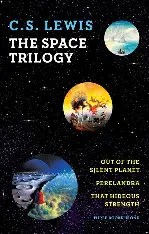
Maybe I’m writing this a little prematurely since I’m only halfway through C.S. Lewis’ Space Trilogy, but I needed something to write about this week, so here we are.
For those of you who didn’t know, The Space Trilogy is a series that C.S. Lewis wrote after coming to an agreement with Tolkien that science fiction too often lacked “what we [Tolkien and Lewis] really like in stories.” Thus, the two literary geniuses set out to write their own works of science fiction as amateurs, with Lewis crafting the Space Trilogy and Tolkien writing the story “The Lost Road,” which later became a big part of the larger “Fall of Numenor” narrative.
Funny enough, you can actually see the influence that Tolkien had on Lewis throughout the Trilogy. For one thing, the main character is Dr. Elwin Ransom, a name that is shared with the narrator of “The Lost Road,” Elwin (a.k.a. Aelfwine.) Ransom is also a philologist from Oxbridge University (Tolkien taught at Oxford), was born the same year as Tolkien, and also fought in WWI and the Somme. Lewis also appears as a narrator – especially in the second book – as a close friend of Ransom’s. As though that wasn’t enough, for the absolute Tolkien nerds reading The Space Trilogy, we can also see similarities in the languages that Tolkien created (particularly Quenya) and Lewis’ language of Old Solar. In Letter 276, Tolkien comments on how the word “Eldil” is related to his word “Eldar” (Elves.) He also commented on how the names Tor and Tinidril are very similar to the names of his characters, Tuor and Idril.
But besides the funny Easter eggs pointing to Lewis’ friendship with Tolkien hidden throughout the story, The Space Trilogy explores an interesting question of what life would be like if the Fall never happened.
In the first book, Ransom is kidnapped by the megalomaniacal scientist, Dr. Weston, and taken to the planet Malacandra (Mars), where he believes he is going to be sacrificed to some alien deity. He escapes Weston and his helper, and eventually meets the locals, of which there are three distinct species, ruled by the Eldil, which are kind of like angelic beings. The people of Malacandra are not entirely untainted as death is a thing that happens there and Ransom finds out that there is such a thing as “bent” hnau (beings), though they’re rare. Overall, though, the Malacandrians stick to following the Eldil, especially Oyarsa, who’s the being sent by the God of The Space Trilogy (Maleldil) to rule Malacandra, and when faced with temptation in the form of Weston, stand fast in their loyalty to Oyarsa and Maleldil.
Then in the second book, Perelandra, the exploration of the question of what life would be like if the Fall never happened grow starker. In this book, Maleldil sends Ransom to the planet, Perelandra (Venus), to save the inhabitants from being corrupted by Weston, who has become possessed by Satan. He arrives and almost immediately meets Tinidril, who is that planet’s version of Eve. She has no knowledge of what sin or death is, only what the will of Maleldil is. However, it’s when Weston arrives that she is tempted to disobey Maleldil by going onto solid land, something that’s the equivalent of the biblical fruit of good and evil on Perelandra.
From here, the story becomes one giant debate, with Weston trying to convince Tinidril to disobey Maleldil and Ransom trying to show her that Weston is evil. It’s at this point where Perelandra begins to almost feel like if the instructions given in The Screwtape Letters were being put into practice. After all, the now demon-possessed Weston doesn’t tell Tinidril outright what his plans are, as we so often think temptation looks like. Instead, he tells her stories about tragic, but powerful women on Earth and how she could be that if she disobeys Maleldil. She can write her own story, and heck, maybe it’s even Maleldil’s will that she goes on the solid land; he’s just holding out on her.
The reason I love this back and forth so much is because it’s one of the best renderings of how the full conversation probably went in the Garden of Eden. The entire thing shows how subtle temptation can be, how it can even seem perfectly logical to go against God, and how easy it is to justify it. In the scenes where Weston is essentially trying to convince Tinidril that it’s actually Maleldil’s hidden will that she disobey, it struck a chord, as I’ve heard the same – or, at least, a similar – argument from staunch atheists, who say that if God exists, it must be His will that they don’t believe in Him, thus, it’s not their fault.
Until next time,
M.J.
Discover more from The Tanuki Corner
Subscribe to get the latest posts sent to your email.


Have something to say? Leave a comment! (Verbal abuse and ad hominem will not be tolerated.)