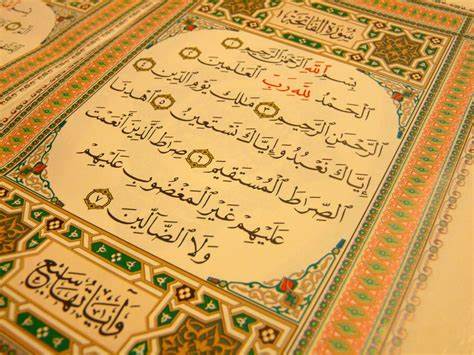
After a week-long break, we’re back to Flippin’ Fatwa Fridy, but this time, we’re no longer in the Introduction, but are finally in the religious text itself. Part of this is because I couldn’t remember everything else wrong with the Introduction and didn’t care to find everything else that was wrong with it, and part of it was because I had already covered the big stuff in it. Maybe I’ll return to it at some point, but for now, let’s look at the first surah.
Surah Al-Fatihah is the first surah (chapter) of the Quran and only consists of seven verses. It’s a short prayer to Allah recognizing that he is (supposedly) the only god who everyone should be praying to. Because of this, there isn’t much to comment on since it’s just there. However, I just want to take a moment to compare how the Quran opens to how the Bible opens. Surah 1, verse 1 opens up saying:
With the name of Allah,
the Most Gracious, the Ever Merciful,
(I commence to read the Holy Book)
It continues:
2. All type of perfect and true praise belongs to Allah alone, the Lord of the worlds,
3. The Most Gracious, the Ever Merciful,
4. Mast of the Day of Requital.
5. (Lord!) You alone do we worship and You alone do we implore for help.
6. Lead us on the exact right path till we reach the goal,
7. The path of those on whom You have bestowed (Your) blessings, those who have not incurred (Your) displeasure, and those who have not gone astray.
Meanwhile, the first words of the Bible, found in Genesis 1:1 (NIV) are:
In the beginning God created the heavens and the earth.
Narratively, what does this do? Well, in the Quran, Al-Fatihah does pretty much nothing except act as a prayer and establish attributes of Allah that, when we continue reading the Quran, Allah never fulfils. Meanwhile, Genesis 1:1 serves as an excellent hook to throw us right into the exposition and it does so simply and beautifully. We want to know more. We want to know how God created the heavens and the earth. We want to know why He did it. We want to follow the story.
Furthermore, Genesis 1:1 tells us more about God and His attributes in one short sentence than the entirety of the first Surah does. One of the marks of great writing is the author’s ability to show, not tell. Genesis 1:1 does this superbly as it shows not just how powerful God is as He created the universe but also shows how good He is that He created the universe. This then gives us a good starting point for belief in God’s promises. His actions in this one verse back up His later words explaining His attributes and show us how if He can create such a complex universe where He pays attention to every tiny detail, surely His promises can be trusted.
Meanwhile, Surah Al-Fatihah does none of that. Instead, it tells us things but doesn’t show things to prove that Allah is “Most Gracious,” “Ever Merciful,” or the only one who deserves our worship. We’re not even sure who Allah is at this point. We have no reason to trust him or take him at face value because at this point, we haven’t seen him do anything that would show that he’s any of those attributes. This is just the first example of how the Quran is so ineffective at giving us any baseline apologetic for why you should trust Allah that you learn more about God and His character in ten words in the Bible than you do in the seven verses that make up Al-Fatihah.
But let’s keep reading. Maybe it’ll get better. (Spoiler: It doesn’t)
Until next time,
M.J.
Discover more from The Tanuki Corner
Subscribe to get the latest posts sent to your email.
 The Tanuki Corner