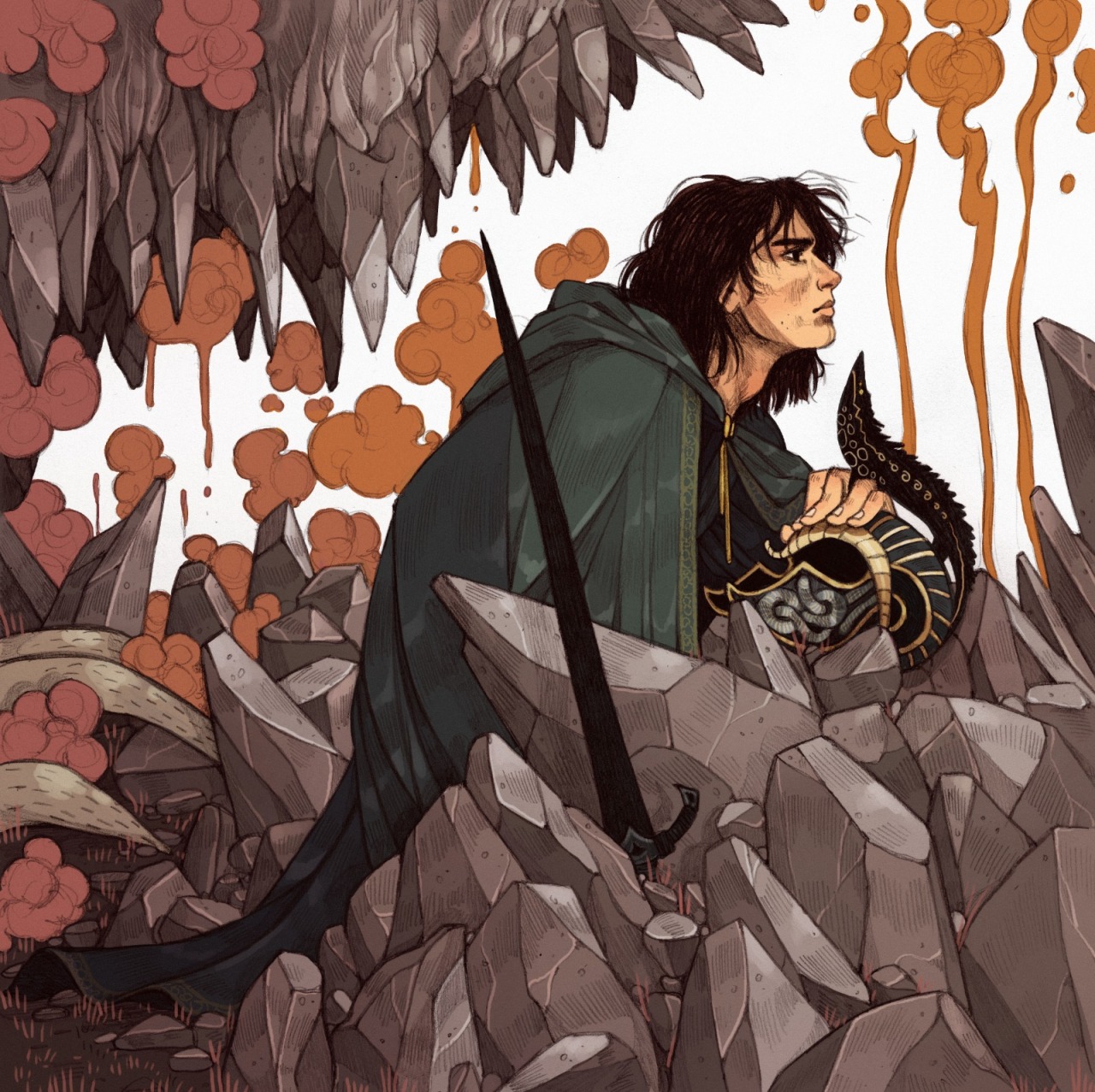
The Children of Hurin, written by J.R.R. Tolkien in the late 1910’s and published in 2007 by his son, Christopher, is one of the three great tales of the First Age. While it is one of the great tales, it’s also the most tragic tale in the entire legendarium, and showcases best the heroic struggle of man vs. sin. Bring a box of tissues, it’s going to get messy. However, despite the dragons and incest, this isn’t Game of Thrones.
#1: The Nirnaeth Arnoediad
The story starts with Turin’s childhood and a big part of it was the Nirnaeth Arnoediad – the Battle of Unnumbered Tears. Already, Turin had lost his sister, Lalaith and now it’s time for him to lose his father, Hurin, and for us to lose a fan-favorite character, High-King Fingon.
Did I mention this is a tradgedy?
While Tolkien’s work isn’t as violent as other works in the same high-fantasy genre, he definitely doesn’t shy away from violence in the chapter about the Nirnaeth. He describes the deaths of the battle in grim detail, telling us about how there were so many that they were piled in a giant hill (the Haudh-en-Nirnaeth). The death of Fingon is especially brutal, as his skull was split open by Gothmog’s axe and his body and standard were trampled in “the mire of his blood”. Even Hurin’s story – though he doesn’t die – is brutal at the end of the Nirnaeth.
#2: Hurin Roasts Morgoth
One of the best scenes in the book is where Morgoth takes Hurin hostage and tries to bribe him into giving away the location of Gondolin. Obviously, Hurin doesn’t do this, but instead calls out Morgoth on his crap, making him either the bravest or most stupid person in the legendarium (or both). Morgoth doesn’t like this and curses Hurin’s family and forces Hurin to watch their downfall. Hurin still takes it stoically and continues to call out Morgoth. Give this man a crown!
#3: Thingol Likes Humans Now
Elu Thingol (who originally comes up in the story of Beren and Luthien), has gone through a lot of character growth since his first appearance. In Beren and Luthien, you got the impression that he didn’t like the race of men, but now that he’s seen that men aren’t so bad, he’s agreed to adopt Turin, a man. This is also a big deal since never before or since has an elf adopted a human child.
#4: Turin Does Some Stuff Right and Screws Up Everything Else
No tragedy would be complete without at least one character who means well, but still fails in the end. In our case, Turin is that character. Does that mean that he’s a bad person? No. Throughout the story, he actually makes some good, honorable decisions (like trying to get rid of Morgoth and avenge his father), though many of them are admittedly rash (like how he goes about trying to dethrone Morgoth which leads to the fall of Nargothrond).
It doesn’t help that the curse that Morgoth set upon him didn’t make anything much easier. Because of this curse, everything goes wrong for him (I guess it’s Morgoth’s Law instead of Murphy’s Law) at the most inconveient times.
#5: Beleg Tried
Beleg Cuthalion is one of the best characters in the book. The dude is unservingly loyal to Turin and tries to be the voice of reason throughout the story. When he can’t reason with Turin, he follows his friend to support him and and gives his life to save him. He’s basically the elvish version of Sam Gamgee.
#6: Saeros Goes on a 5K Run, Glaurung Needs a Weight Loss Program and Talking Swords
There are only three funny scenes in this book, and two of them might just be funny to me since I have a strange sense of humor.
The first laughable scene is where Saeros tries to fight Turin and is almost instantly bested. From there, instead of killing him, Turin makes a mockery of Saeros by making him run naked through the woods while stabbing him in the butt with his sword. This, of course, rouses the interest of some of the other elves and they also start chasing after Turin and Saeros. While I’m sure it was terrifying for Saeros, it was funny for the reader. Don’t worry: no elves were harmed in this joke.
Oh wait, Saeros died. Nevermind.
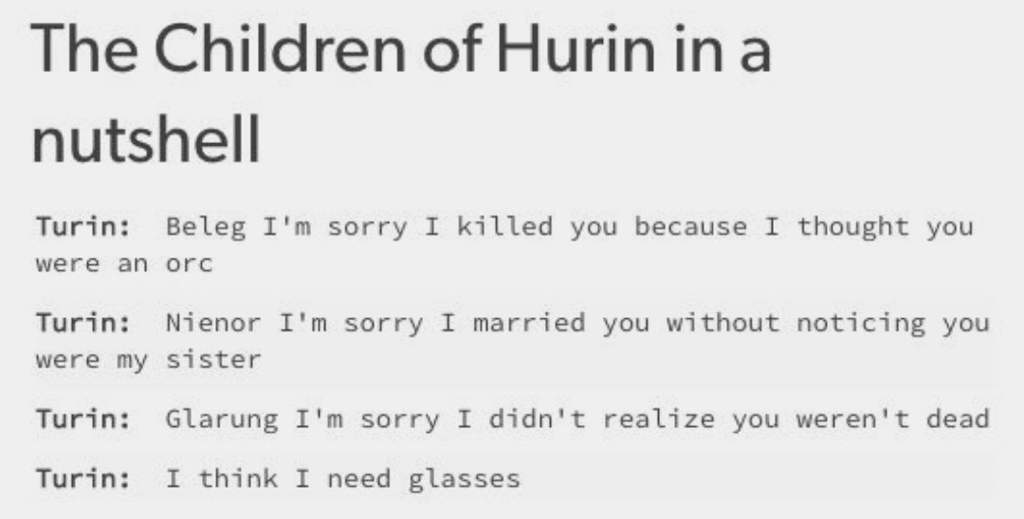
The second comes just before Glaurung’s death. I think this meme sums it up pretty well:

From the looks of it, Glaurung needed to do some exercise before coming out of Nargothrond. Maybe it would’ve saved him from being stabbed to death.
Lastly, Turin’s talking sword felt almost absurd when I read it. The entire conversation is literally:
TURIN: Hi, sword! I found out I married my sister and she’s now dead. Wanna kill me?
GURTHANG: Sure! Your buddy’s blood tasted gross. I need something to get that out of my steel.
Everyone, if you are having suicidal thoughts and have turned to talking to any sharp, pointy implements in your house, be that a sword or a butter knife, get help immediatly. If the sharp, pointy implement starts talking back to you, you may also want to get a detox and start considering not eating psychedelic mushrooms. There are always people who want to help you get back on the right path.
#7: Mablung’s Reaction to Everything
I’m pretty sure Mablung is supposed to be the reader at the end of the book. Why? Because he had the same reaction as all of us and that is: “What the hell just happened?! Why’s everyone dead?!” With that in mind, if you want to read Children of Hurin, I would highly recommend it.
Until next time,
M.J.
Discover more from The Tanuki Corner
Subscribe to get the latest posts sent to your email.
 The Tanuki Corner
Have something to say? Leave a comment! (Verbal abuse and ad hominem will not be tolerated.)