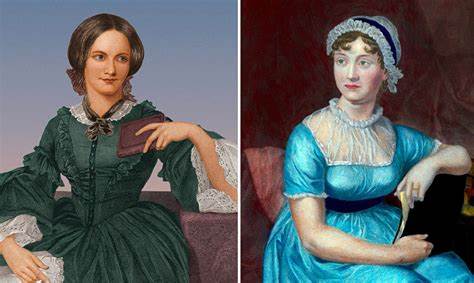
Voice is one of the most important aspects of writing. Everyone has a unique style in their writing that distinguishes it from the works of other people. Voice in writing is created using vocabulary, different grammatical choices, and overall style (i.e. 1st-person narration, genre, etc.) For example, a book written by an author hailing from the South during the 1800s will have a different voice than an author from the North around the period. They may use different grammar, vocabulary, and the overall genres may be different, making their writing unique. To illustrate this point, we should compare two of the most famous authors in history, Jane Austen and Charlotte Bronte. Both of these women are best known for their romances: Pride and Prejudice (Jane Austen) and Jane Eyre (Charlotte Bronte.) However, though these fall into a larger genre of romance, and though they lived in a time where social norms were similar, their voices couldn’t be more different.
To start with Jane Austen’s work, let’s look at the opening two sentences of Pride and Prejudice:
It is a truth universally acknowledged, that a single man in possession of a large fortune must be in want of a wife. However little known the feelings or views of such a man may be on his first entering a neighborhood, this truth is so well fixed in the minds of the surrounding families, that he is considered the rightful property of someone or other of their daughters.
From this, we can see two things. First, Austen is writing from the perspective of a detached, somewhat amused narrator. She doesn’t insert herself into the plot, but rather comments on it as it goes, reporting what’s happening with an edge of satire. It’s not overly emotional but puts down the facts and sets up the plot in a subtly witty manner.
The second thing we can see here is that her style of writing is more akin to a subgenre of realism. In the first sentence, we see that Jane Austen, in writing the story, intends to comment on a common element in the social fabric of Regency Era England: finding a husband of good fortune. The witty, detached way that she writes these first sentences aids in her commentary. It’s not over the top and extremely emotional, as was common in romance at the time. It’s clear from the outset that she intended to make the book as close to real life as she could.
Compare this, now, to the opening paragraph of Jane Eyre:
There was no possibility of taking a walk that day. We had been wandering, indeed, in the leafless shrubbery an hour in the morning; but since dinner (Mrs. Reed, when there was no company, dined early) the cold winter wind had brought with it clouds so somber, and a rain so penetrating, that further out-door exercise was now out of the question.
This opening differs drastically from what we see in Pride and Prejudice in several ways. First, the hook’s purpose is different. While Jane Austen’s hook was intended to set up the main plot and conflict of her story, Charlotte Bronte’s intention was clearly to set the mood for the book. The opening paragraph grabs your attention by created unanswered questions and creates a moody, foreboding atmosphere that pervades the story. It doesn’t give any clues to what the plot will be except that the story is likely going to be heavy.
The second difference – that it’s written in the 1st –person perspective – further adds to this atmosphere. The tone is emotional, showing the narrator’s disappointment. It’s almost introspective, too, as she goes on to describe the weather in great detail in a way that seems to foreshadow her own emotions later in the book.
The combination of these differences lends itself to the third difference, which is genre. While Austen wrote with a sense of realism, Bronte was writing in line with the gothic subgenre. This genre was an offshoot of the overall romantic movement, which highly emphasized emotion and aesthetics. The opening paragraph of Jane Eyre, even without knowing what genre it was written in, evokes images in line with gothic literature, with the emotional description, introspective nature, and brooding atmosphere.
Another example where we see the difference between the two authors is in the scenes where the heroines and their love interests clash. In chapter 34 of Pride and Prejudice, Elizabeth has just found out that Mr. Darcy encouraged his friend, Mr. Bingley, to cease courting her sister, Jane. Mr. Darcy doesn’t know that she knows what he did and goes to ask her to marry him. Austen writes:
She could not think of Darcy’s leaving Kent without remembering that his cousin was to go with him; but Colonel Fitzwilliam had made it clear that he had no intentions at all, and agreeable as he was, she did not mean to be unhappy about him.
While settling this point, she was suddenly roused by the sound of the door-bell, and her spirits were a little fluttered by the idea of its being Colonel Fitzwilliam himself, who had once before called late in the evening, and might now come to inquire particularly after her. But this idea was soon banished, and her spirits were very differently affected, when, to her utter amazement, she saw Mr. Darcy walk into the room. In an hurried manner he immediately began an enquiry after her health, imputing his visit to a wish of hearing that she were better. She answered him with cold civility. He sat down for a few moments, and then getting up, walked about the room. Elizabeth was surprised, but said not a word. After a silence of several minutes, he came towards her in an agitated manner, and thus began —
In vain have I struggled. It will not do. My feelings will not be repressed. You must allow me to tell you how ardently I admire and love you.’
Elizabeth’s astonishment was beyond expression. She stared, coloured, doubted, and was silent. This he considered sufficient encouragement; and the avowal of all that he felt, and had long felt for her, immediately followed. He spoke well; but there were feelings besides those of the heart to be detailed, and he was not more eloquent on the subject of tenderness than of pride. His sense of her inferiority — of its being a degradation — of the family obstacles which judgment had always opposed to inclination, were dwelt on with a warmth which seemed due to the consequence he was wounding, but was very unlikely to recommend his suit.
In spite of her deeply rooted dislike she could not be insensible to the compliment of such a man’s affection, and though her intentions did not vary for an instant, she was at first sorry for the pain he was to receive; till, roused to resentment by his subsequent language, she lost all compassion in anger. She tried, however, to compose herself to answer him with patience, when he should have done. He concluded with representing to her the strength of that attachment which, in spite of all his endeavours, he had found impossible to conquer; and with expressing his hope that it would now be rewarded by her acceptance of his hand. As he said this, she could easily see that he had no doubt of a favourable answer. He spoke of apprehension and anxiety, but his countenance expressed real security. Such a circumstance could only exasperate farther, and, when he ceased, the colour rose into her cheeks, and she said —
‘In such cases as this, it is, I believe, the established mode to express a sense of obligation for the sentiments avowed, however unequally they may be returned. It is natural that obligation should be felt, and if I could feel gratitude, I would now thank you. But I cannot — I have never desired your good opinion, and you have certainly bestowed it most unwillingly. I am sorry to have occasioned pain to any one. It has been most unconsciously done, however, and I hope will be of short duration. The feelings which, you tell me, have long prevented the acknowledgment of your regard, can have little difficulty in overcoming it after this explanation.’
Mr. Darcy, who was leaning against the mantlepiece with his eyes fixed on her face, seemed to catch her words with no less resentment than surprise. His complexion became pale with anger, and the disturbance of his mind was visible in every feature. He was struggling for the appearance of composure, and would not open his lips till he believed himself to have attained it. The pause was to Elizabeth’s feelings dreadful. At length, in a voice of forced calmness, he said —
And this is all the reply which I am to have the honour of expecting! I might, perhaps, wish to be informed why, with so little endeavour at civility, I am thus rejected. But it is of small importance.’
‘I might as well inquire,’ replied she, ‘why with so evident a design of offending and insulting me, you chose to tell me that you liked me against your will, against your reason, and even against your character? Was not this some excuse for incivility, if I was uncivil? But I have other provocations. You know I have. Had not my own feelings decided against you — had they been indifferent, or had they even been favourable, do you think that any consideration would tempt me to accept the man who has been the means of ruining, perhaps for ever, the happiness of a most beloved sister?’
As she pronounced these words Mr. Darcy changed colour; but the emotion was short, and he listened without attempting to interrupt her while she continued —
‘I have every reason in the world to think ill of you. No motive can excuse the unjust and ungenerous part you acted there. You dare not, you cannot deny that you have been the principal, if not the only means of dividing them from each other — of exposing one to the censure of the world for caprice and instability, the other to its derision for disappointed hopes, and involving them both in misery of the acutest kind.’
The passage goes on, but it is an excellent example of Jane Austen’s voice. The scene is emotional and is a turning point in the story but isn’t overly dramatic. Austen, once again, is detached from the scene, simply reporting what happened. She skips over dialogue that would have been unnecessary and goes directly to the main conflict in the conversation. Description is used, but it is done so sparingly. Much of the emotion of the scene can be found in the overall tone of the dialogue.
A similar scene occurs in Jane Eyre in chapter 27. Jane has found out on what is supposed to be the day of her wedding to Mr. Rochester, that he is still technically married to his wife, Bertha Mason, who has gone insane. The wedding is called off, and in this passage, Mr. Rochester tries to explain himself to Jane. Charlotte Bronte writes:
Some time in the afternoon I raised my head, and looking round and seeing the western sun gilding the sign of its decline on the wall, I asked, “What am I to do?”
But the answer my mind gave–“Leave Thornfield at once”–was so prompt, so dread, that I stopped my ears. I said I could not bear such words now. “That I am not Edward Rochester’s bride is the least part of my woe,” I alleged: “that I have wakened out of most glorious dreams, and found them all void and vain, is a horror I could bear and master; but that I must leave him decidedly, instantly, entirely, is intolerable. I cannot do it.”
But, then, a voice within me averred that I could do it and foretold that I should do it. I wrestled with my own resolution: I wanted to be weak that I might avoid the awful passage of further suffering I saw laid out for me; and Conscience, turned tyrant, held Passion by the throat, told her tauntingly, she had yet but dipped her dainty foot in the slough, and swore that with that arm of iron he would thrust her down to unsounded depths of agony.
“Let me be torn away,” then I cried. “Let another help me!”
“No; you shall tear yourself away, none shall help you: you shall yourself pluck out your right eye; yourself cut off your right hand: your heart shall be the victim, and you the priest to transfix it.”
I rose up suddenly, terror-struck at the solitude which so ruthless a judge haunted,–at the silence which so awful a voice filled. My head swam as I stood erect. I perceived that I was sickening from excitement and inanition; neither meat nor drink had passed my lips that day, for I had taken no breakfast. And, with a strange pang, I now reflected that, long as I had been shut up here, no message had been sent to ask how I was, or to invite me to come down: not even little Adele had tapped at the door; not even Mrs. Fairfax had sought me. “Friends always forget those whom fortune forsakes,” I murmured, as I undrew the bolt and passed out. I stumbled over an obstacle: my head was still dizzy, my sight was dim, and my limbs were feeble. I could not soon recover myself. I fell, but not on to the ground: an outstretched arm caught me. I looked up–I was supported by Mr. Rochester, who sat in a chair across my chamber threshold.
“You come out at last,” he said. “Well, I have been waiting for you long, and listening: yet not one movement have I heard, nor one sob: five minutes more of that death-like hush, and I should have forced the lock like a burglar. So you shun me?–you shut yourself up and grieve alone! I would rather you had come and upbraided me with vehemence. You are passionate. I expected a scene of some kind. I was prepared for the hot rain of tears; only I wanted them to be shed on my breast: now a senseless floor has received them, or your drenched handkerchief. But I err: you have not wept at all! I see a white cheek and a faded eye, but no trace of tears. I
suppose, then, your heart has been weeping blood?”
“Well, Jane! not a word of reproach? Nothing bitter—nothing poignant? Nothing to cut a feeling or sting a passion? You sit quietly where I have placed you, and regard me with a weary, passive look.”
“Jane, I never meant to wound you thus. If the man who had but one little ewe lamb that was dear to him as a daughter, that ate of his bread and drank of his cup, and lay in his bosom, had by some mistake slaughtered it at the shambles, he would not have rued his bloody blunder more than I now rue mine. Will you ever forgive me?”
Reader, I forgave him at the moment and on the spot. There was such deep remorse in his eye, such true pity in his tone, such manly energy in his manner; and besides, there was such unchanged love in his whole look and mien–I forgave him all: yet not in words, not
outwardly; only at my heart’s core.
“You know I am a scoundrel, Jane?” ere long he inquired wistfully– wondering, I suppose, at my continued silence and tameness, the result rather of weakness than of will.
“Yes, sir.”
“Then tell me so roundly and sharply–don’t spare me.”
“I cannot: I am tired and sick. I want some water.” He heaved a sort of shuddering sigh, and taking me in his arms, carried me downstairs. At first I did not know to what room he had borne me; all was cloudy to my glazed sight: presently I felt the reviving warmth of a fire; for, summer as it was, I had become icy cold in my chamber. He put wine to my lips; I tasted it and revived; then I ate something he offered me, and was soon myself. I was in the library–sitting in his chair–he was quite near. “If I could go out of life now, without too sharp a pang, it would be well for me,” I thought; “then I should not have to make the effort of cracking my heart-strings in rending them from among Mr. Rochester’s. I must leave him, it appears. I do not want to leave him–I cannot leave him.”
“How are you now, Jane?”
“Much better, sir; I shall be well soon.”
“Taste the wine again, Jane.”
I obeyed him; then he put the glass on the table, stood before me, and looked at me attentively. Suddenly he turned away, with an inarticulate exclamation, full of passionate emotion of some kind; he walked fast through the room and came back; he stooped towards me
as if to kiss me; but I remembered caresses were now forbidden. I turned my face away and put his aside.
“What!–How is this?” he exclaimed hastily. “Oh, I know! you won’t kiss the husband of Bertha Mason? You consider my arms filled and my embraces appropriated?”
“At any rate, there is neither room nor claim for me, sir.”
“Why, Jane? I will spare you the trouble of much talking; I will answer for you–Because I have a wife already, you would reply.–I guess rightly?”
“Yes.”
“If you think so, you must have a strange opinion of me; you must regard me as a plotting profligate–a base and low rake who has been simulating disinterested love in order to draw you into a snare deliberately laid, and strip you of honour and rob you of self-respect. What do you say to that? I see you can say nothing in the first place, you are faint still, and have enough to do to draw your breath; in the second place, you cannot yet accustom yourself to accuse and revile me, and besides, the flood-gates of tears are opened, and they would rush out if you spoke much; and you have no desire to expostulate, to upbraid, to make a scene: you are thinking how TO ACT–TALKING you consider is of no use. I know you- -I am on my guard.”
“Sir, I do not wish to act against you,” I said; and my unsteady voice warned me to curtail my sentence.
“Not in your sense of the word, but in mine you are scheming to destroy me. You have as good as said that I am a married man–as a married man you will shun me, keep out of my way: just now you have refused to kiss me. You intend to make yourself a complete stranger to me: to live under this roof only as Adele’s governess; if ever I say a friendly word to you, if ever a friendly feeling inclines you again to me, you will say,–‘That man had nearly made me his
mistress: I must be ice and rock to him;’ and ice and rock you will accordingly become.”
I cleared and steadied my voice to reply: “All is changed about me, sir; I must change too–there is no doubt of that; and to avoid fluctuations of feeling, and continual combats with recollections and associations, there is only one way–Adele must have a new governess, sir.”
Here, we see a similar scene playing out to chapter 34 of Pride and Prejudice as these characters are both trying to work out a misunderstanding. However, following with the 1st-person point of view and the overall emotional quality of Jane Eyre, Charlotte Bronte does not hold back in describing how Jane feels. The dialogue in of itself is description enough for the emotions felt by each person, but the opening lines of chapter 27 are intensely emotional. They are dramatic and foreshadow the drama that comes by the end of chapter 28 where the dialogue continues.
In the passages examined, we can see two examples of how voice distinguishes between authors. While Jane Austen is known for her detached and witty style of writing, Charlotte Bronte is known for her emotional, passionate, and intensely involved style. Because of these differences, each writer is unique in how they craft their stories and characters.
Until next time,
M.J.
Discover more from The Tanuki Corner
Subscribe to get the latest posts sent to your email.
 The Tanuki Corner
Have something to say? Leave a comment! (Verbal abuse and ad hominem will not be tolerated.)