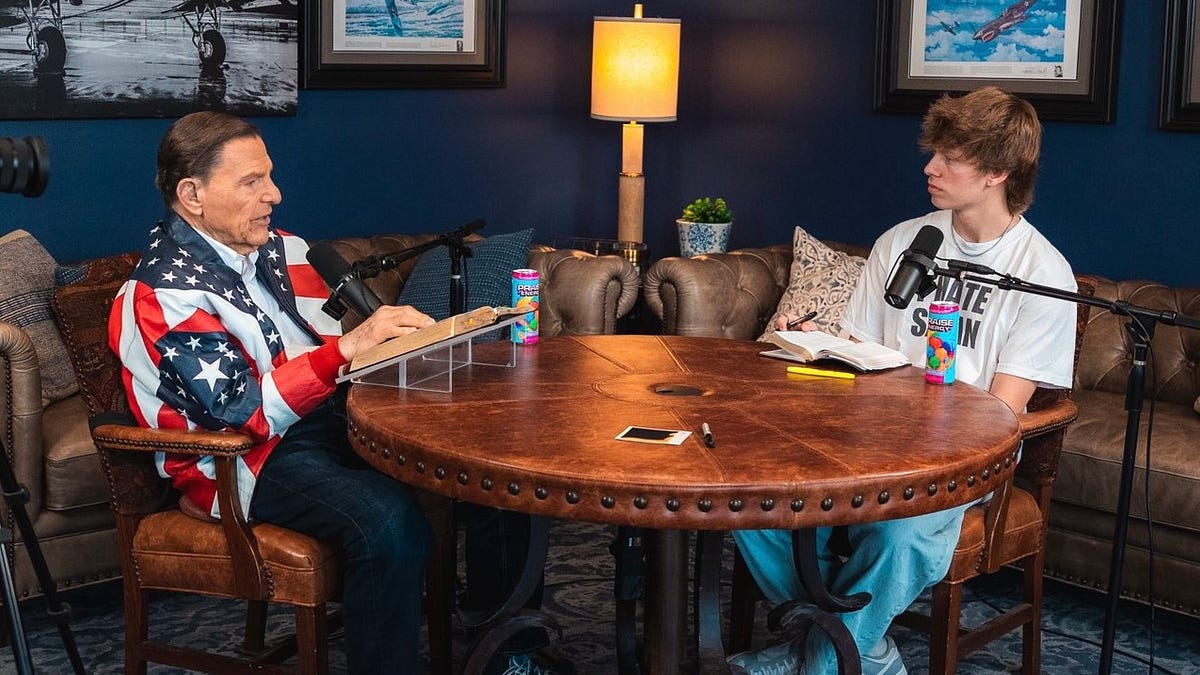
Last week, there was somewhat of a stir in the Christian space on YouTube. The reason for this is because Bryce Crawford (who I’ve spoken extensively about here on the blog) had the highly controversial and greatly deceptive Kenneth Copeland on his show. There was a lot of buzz about this since not only was it Copeland’s first interview in 15 years, but it was one of the biggest Christian voices online giving him a platform. This news was so big that Good Fight Ministries did an hour-and-a-half-long livestream talking about why this was a bad thing.
Then, on Monday, the interview came out. Bryce made it very clear that he does not agree with the prosperity gospel and acknowledged that Copeland teaches a “different gospel” (“false gospel” is more accurate.) From there, the interview was 70% Copeland telling stories about his life, 29% him defending the prosperity gospel by taking Scripture out of context, and 1% Bryce asking softball questions.
However, while I could dedicate this entire blog post to talking about everything wrong with that interview, or how people like Good Fight Ministries are starting to notice that Bryce is a false teacher, the thing I want to focus on today are the ethics. Should Christians online be platforming certain people who teach a false gospel? Where do we draw the line in the sand?
Though I have seen some people do a good job of bringing on people with differing religious backgrounds in the name of a common goal without promoting one view or another (for example: David Wood and Apostate Prophet (Ridvan Aydemir) often collab though Wood is Protestant and Aydemir is Eastern Orthodox) I do think it can be a bad idea. This isn’t anything against these people, but as a Christian influencer, you have a responsibility to vet who you’re platforming and, likewise, allowing to influence your followers. And in the case of known heretics who try to pass themselves off as believing the same or similar things as other believers while teaching something that’s incredibly deceptive, you shouldn’t give them the light of day, especially if you yourself are ill-equipped or unwilling to push back on their beliefs.
In the case of Bryce bringing on Kenneth Copeland, this is absolutely something where he shouldn’t be given the light of day. His main power is manipulation. He has the ability to cover deception with misquoted Scripture that he knows most people won’t catch and a charismatic personality. He tries to play himself off as a normal Christian like anyone else who has just figured out how to get God’s blessings. He makes it sound like the Prosperity Gospel that he preaches is an accurate reading of the Bible – just turn your brain off, listen to him, and you’ll be fine.
Further, when bringing on someone of differing beliefs, ask yourself if the collab will actually be good for the audience. Remember, most of your audience probably doesn’t have good discernment, so if you’re platforming someone that teaches a gospel that doesn’t line up with the Bible, it’s possible that many of them won’t catch the issues. While you might get plenty of clicks and views, if they can’t distinguish a wolf from a sheep, then you end up hurting them more than you’re helping them.
On that note, if you’re bringing on someone controversial who you know is a false teacher just for views and attention, then you shouldn’t have them on period. In Bryce’s case, while I don’t claim to know his heart, it seems very much like his interview with Copeland was done to generate views. After all, it was Copeland’s first interview in 15 years, and he rightly has drawn the ire of many in the church. Add on that this isn’t Bryce’s first time having a controversial figure on, collaborating with Carl Lentz back in December of 2024 and January of 2025, and this seems like a trend.
Thus, I think it needs to be a rule of thumb for Christian influencers that if they want to bring someone on their podcast who’s controversial or believes in questionable doctrines, they need to first ask themselves if the discussion will truly benefit the audience or if it will simply give the guest access to a broader range of people who they may end up deceiving. If the latter, then it’s best not to have them on.
On that note, the second thing the influencer needs to ask themselves is if they’re actually prepared and willing to give a respectful, but firm and clear rebuttal against anything that the guest may say that goes against Scripture (basically, they need to be prepared to do the discernment part that the audience may not be willing or equipped to do.) They need to understand the arguments and be willing to protect the flock if the guest tries preying on the audience with a nice sounding, but false message. Just saying that you don’t agree with the person or that they teach a different gospel is not enough. You need to demonstrate for the audience how they’re teaching a false gospel via a sound rebuttal.
And third, they need to ask themselves the reason for bringing on the person. Is it to have a discussion and respectful debate about the points of contention? Or is it simply to garner attention online, even if it means potentially harming your audience’s spiritual walk because they don’t know how to tell a wolf from a sheep?
If you’re not willing to ask these questions, or you’re just doing it for the clicks, then you shouldn’t be bringing the person on.
Until next time,
M.J.
Discover more from The Tanuki Corner
Subscribe to get the latest posts sent to your email.


Have something to say? Leave a comment! (Verbal abuse and ad hominem will not be tolerated.)