About a week or so ago, I got a request from a commenter asking if I would write a post about science and my stance on that. I said that was a bit broad and asked them to narrow it down. The commenter got back to me and requested that I write a post about Young Earth Creationism (YEC) and my stance on that, as well as a post about what I think about the COVID pandemic and vaccine. I thought that was a cool suggestion, so today, I’ll address YEC and the arguments for and against it. As for the post about the COVID pandemic and vaccine, that will have to wait until next week or so.
Young Earth Creationism, for those who don’t know, is the belief that the world was created in 6 literal days and that the Earth is less than 10,000 years old rather than 4.5 billion years old as believed by scientists. This belief is taught in the Bible and, once upon a time, was the mainstream view. However, this belief has been being challenged since at least the 19th century, and, in more recent years, YEC has increasingly fallen to the wayside in the church, being replaced instead with Old Earth Creationism, which includes theories such as progressive creationism, day-age theory, gap theory, and theistic evolution. Those who hold to a young Earth view are now generally perceived as ignorant, biased, or unsophisticated. So, is there any evidence to support a Young Earth view?
The place where we need to start with before we go into this is establishing the scientific evidence that supports the presupposition that there is a God. After all, if there’s no evidence for God, then there’s no point in arguing for a young Earth.
Atheists will argue for a naturalistic approach to creation. Various theories have been created to explain this. The most popular states that the universe just happened to form because the particles (somehow) were always there. Another says that the universe was one of many universes that happened to be perfect for supporting life, and some even absurdly suggested that the laws of physics were different in the past, allowing the universe to form.
However, these theories run into a teensy-ensie problem. Spontaneous generation is a theory that has been disproven since the mid-1600s. Nothing comes to be without a cause. You wouldn’t look at a tree and think, “Yeah, that tree has always been there.” You would instead think, “That tree grew from a seed, and that seed probably came from another tree.” On that same note, it’s an established fact that order can’t come from non-order. So, the naturalistic approach fails because it can’t explain where in the world the particles that created the universe came from, where the multiverse came from, or how the laws of physics came to be and how or why they changed.
Another tiny problem for the naturalistic explanation for the universe’s formation is the astronomically low chances of a universe forming in such a way to produce life. According to physicist Lee Smolin, the odds of that happening are 1 in 10^299. That means that only one universe out of 10 followed by 299 zeroes could support life. To put that in perspective, the chances of you readers cracking my 7-digit phone pin is 1 in 10 million.
For further perspective, when my dad was stationed in Japan, there was a bar off base. On day, he decided to go there, and the bar tender asked what beer he would like, saying it was free. Dad ordered and asked why it was free. The bar tender then went on to explain that one of the guys there had hit the jackpot on one of the games at the bar, so he was paying for the drinks. A few minutes went by, and the guy who had hit the jackpot hit it again. A few more minutes, and the same thing happened. The dude hit three jackpots in one day.
Now, the bar tender was confused as to how this guy managed to hit three jackpots, so he called the company who made the game. They told him to take it offline immediately, as something had malfunctioned since the odds of winning three jackpots were over 1 in a trillion.
Now compare that to the odds of the universe forming. I think you get the picture. But I’m not done just yet.
In the event that the universe could form naturally in a way suitable for life, you run into the issue of how life can form naturally in the first place. According to the Miller-Urey Experiment, it’s possible that amino acids, the building blocks of life, could’ve formed naturally under the right combinations of various gasses, water, and electricity. However, there’s a problem with that, too.
In the unlikely event that amino acids could have formed naturally, in order for amino acids to form proteins, there need to be at least 400 amino acids in a chain or more. More specifically, those amino acids are 1 of 20 different kinds, in which 19 out of 20 of those are left or right-handed (they link up either on the left side or the right side). The left-handed amino acids are the ones needed for life to exist, and the chances of those linking together in a string of 400 by chance is less than .5^380.

The odds of a specific protein forming is 1 in 10^74 and the chances of the simplest cell – which needs over 120 proteins – forming is less than 1.08×10^-13,727. The odds of a single bacterium forming from that primordial soup is an estimated 1 in 10^40K. To even get the needed proteins, you have to assume that there are 10^100 universes, and even with those absurdly generous conditions, you only have a probability of 6.64×10^13,193.
These numbers are staggering, and from that, scientists believe that 15 billion years wouldn’t even be enough for a single bacterium to form, much less the 13.8 billion years that the universe is estimated to be (more on that in a sec). To make matters worse, the chance of a bacterium forming in 15 billion years is 6.64×10^-13,641.
“Impossible” doesn’t even begin to describe this, especially when you take into consideration how low the odds are for proteins to form a double helix, for DNA to form with the correct instructions, or getting the RNA and other molecules necessary for decoding the DNA and building the cell. Or how low the chances of life evolving from simple cells into more complex organisms is. As one example to show how absurd this line of thinking is, I’ll let David Wood explain with this analogy:
The only way that one can adequately explain how anything in this world has been formed is if there is a God who formed it.
So, now that the foundation for the possibility of a young Earth has been laid via evidence for God’s existence, we can get into the discrepancy between what scientists say and what creationists say.
Scientists say that the universe is 13.8 billion years old, a number that they determined through measuring the age of the oldest stars. How this works is that the smaller a star is, the less mass it has, which means it’ll be able to burn longer, with scientists predicting that they can burn for at least 20 billion years. With that in mind, scientists then look for globular clusters, which are dense collections of around a million stars that all formed at about the same time. Thus, by determining the mass of those stars, scientists can figure out how old the cluster is, estimating the age of the universe. The oldest cluster they’ve found is estimated to be 11-18 billion years old.
Other ways that they’ve been able to determine how old the universe is through cosmic background radiation clocks and the Hubble Constant, amongst other things. For the sake of time, you can read the explanation for those things here.
However, there’s something funky going on with the estimated age of the universe. Though it’s generally accepted that the universe is 13.8 billion years old, a group of scientists has also announced that it’s actually 12.6 billion years old. That’s a difference of 1.2 billion years. That’s not a small difference.
But moving away from the argument over how old the universe is, let’s look at the age of the Earth, which also poses an issue for the naturalistic explanation of things.
Scientists also say that the Earth is several billion years old, however, this claim runs into multiple problems. First are discrepancies in the rock layers. There is a complete lack of activity from life, erosion, or soil layers at the surface of various strata, that would be expected if they existed for several thousand years before being pushed down by other layers.
Second, some fossils (mainly trees) cut vertically through numerous layers of strata. Had those trees been buried naturally over thousands of years, they would not have fossilized. We wouldn’t even know they were there. This points to a quick, sudden burial with numerous layers of sediment quickly covering them, forming the layers we see in the rock.
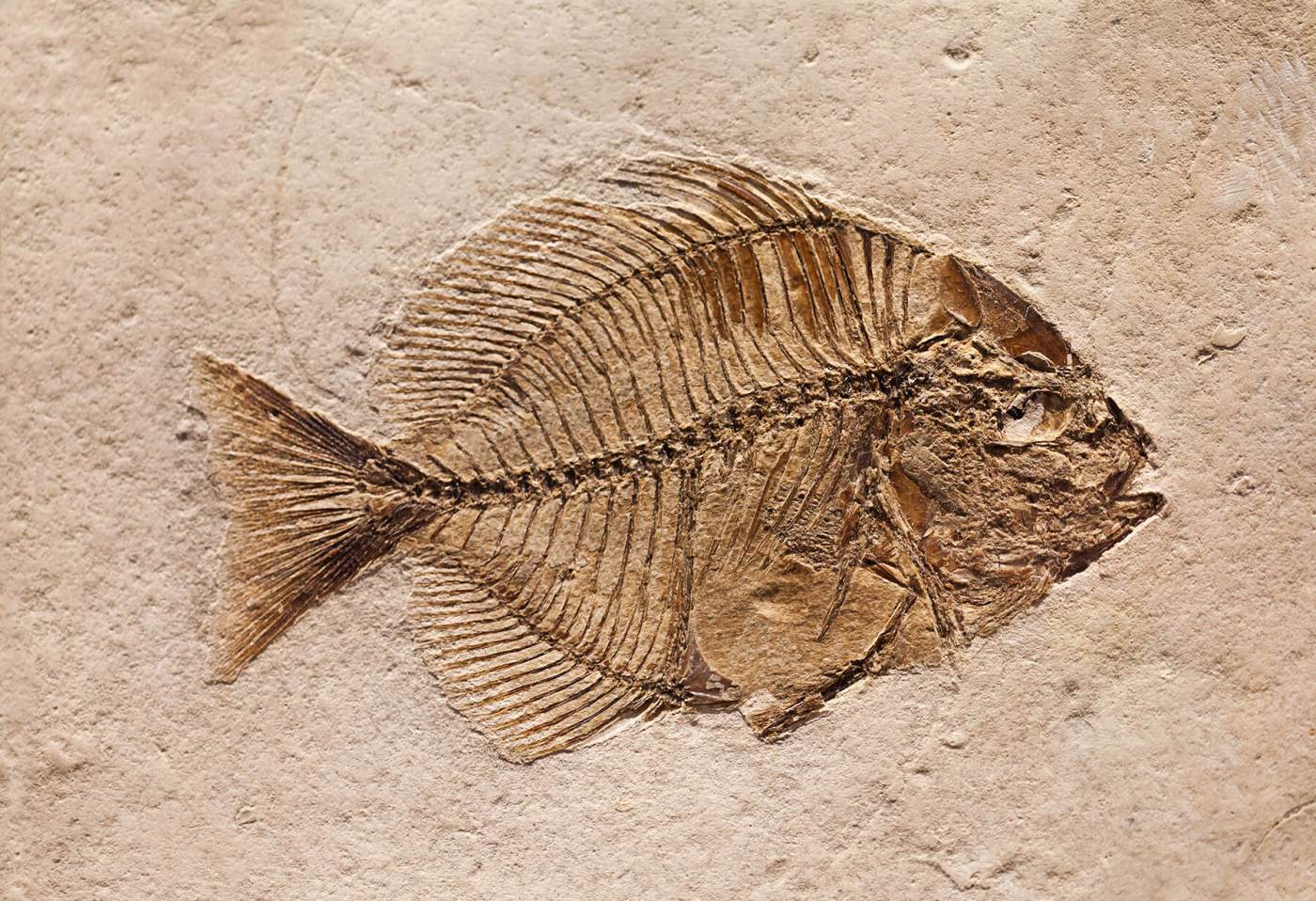
On that note is also the strange fact that scientists have uncovered dinosaur skeletons that still have soft tissues (such as skin), blood cells, and other things that should never have survived millions of years of burial. This means they were (once again) buried quickly (often alive) and fossilized before scavengers, microbes, etc. could get to them. Sure, this could’ve happened due to something like a volcanic eruption and it’s possible that an asteroid hitting the Earth could’ve led to fossilization in the areas nearest to the blast zone, but it doesn’t explain why we have so many fossils lying around everywhere.
[Author’s Note: This also isn’t mentioning the numerous other problems the fossil record poses for evolution. As though evolution couldn’t run into any more flaws….]
Third are the bent and folded sedimentary layers. Usually, bending and folding would point to a process involving lots of heat and pressure, but that leads to metamorphosis, and many of those layers show no evidence of metamorphism. That means that they had to be soft and wet when the earth’s movements formed them.
Fourth, there are major issues with radio-carbon dating. The biggest issue that carbon dating has to face is how carbon-14 levels fluctuate. For example, scientists in the Middle East found that carbon dating was off by an average of 19 years when compared to tree rings dating back to 1610. If it was off by that much for something that was around fairly recently in the grand scheme of things, how much worse are the measurements for the age of fossils and other things?
This also doesn’t mention some of the other issues with the Old Earth Theory, such as how little sediment there is on the seafloor, how little the sun has brightened (if it’s truly 4.6 billion years old, it should have brightened by 40% and significantly affected the Earth’s temperature, something that the geological record does not support), how little salt there is in the sea, etc. Thus, there is good scientific evidence pointing to a young Earth.
Further, in Christian circles, the rejection of the doctrine of a Young Earth poses a problem because it turns chapters that are very clearly meant to be seen as a history both in the context of Genesis and the rest of the Bible, into mythology. It’s simply not a view that can be supported by the Bible, and, if this view is true, then one must ask what else in the Bible is mythology.
Another issue this view raises is that if the world is billions of years old and the fossil record is millions of years old, then it flies in the face of Genesis 3. The Bible very clearly teaches that pre-Fall, there was no death. That only came after Adam sinned. Thus, if the old-earth theory is correct, then Genesis 3 is lying because there was clearly death before sin entered the picture.
The Old Earth Creation Theory also makes God look like a bumbling fool. After all, what God would create the Earth, leave it covered in water for millions of years, then make land and plants that reproduce for millions of years without a sun? And why would he declare everything “very good” if he had created the world via evolutionary processes that left behind a massive, fossilized graveyard when death is the enemy? (1 Cor. 15:26)
Old Earth Creationism not only is a view that’s becoming increasingly hard to support with science when there’s evidence that points against it, but it’s also a view that the Bible does not support. It not only becomes a tangible problem that we need to explain, but it also becomes a spiritual issue, calling into question the character of God and the historical reliability of the Bible, going far beyond a few chapters in Genesis.
Until next time,
M.J.
Discover more from The Tanuki Corner
Subscribe to get the latest posts sent to your email.
 The Tanuki Corner
Well done, nicely put!
LikeLike