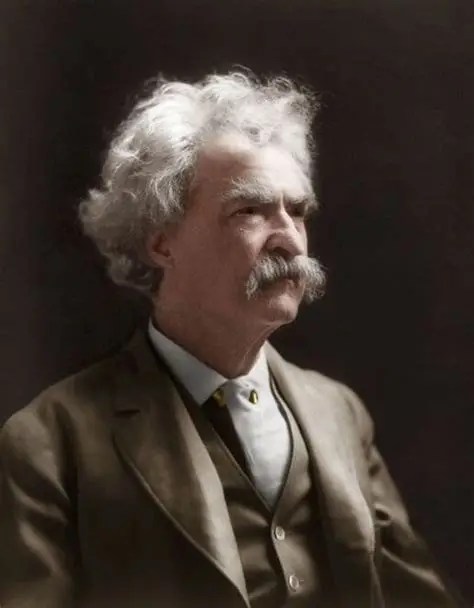
Mark Twain is easily one of the most recognizable names in literature, as his work is still relevant today (2). He forever influenced literature, social commentary, and culture (2). His work is undeniably American, though much of it was also inspired by his travels to other countries. The stories he told weren’t just about the fictional lives of Tom Sawyer and Huck Finn but also engaged in satire to address the issues in society from racism and slavery to imperialism. Inspired by his upbringing, travels, and overall outlook on life, he forever impacted American literature, giving Americans a new appreciation of their national voice and helping shape our national identity(6, 2).
Born in 1835 shortly after an appearance of Halley’s Comet (7), Mark Twain was not christened as “Mark Twain.”(1) His actual name was Samuel Langhorne Clemens (1, 2) and he was born prematurely as the sixth child of John Marshall and Jane Clemens(8). Because of his premature birth, he was very sickly growing up, which led his mother to coddle him, trying to cure him with many allopathic and hydropathic remedies (8). He managed to survive childhood with only three of his siblings – Orion, Pamela, and Henry – surviving with him (7). His sister, Margaret had died when Twain was four, and his brother, Benjamin, died when he was seven (8).
Despite the deaths of his siblings, Twain still had a sense of humor, which he inherited from his mother, who was the opposite of his father (8). His father was very stern, something that was made worse by a string of business failures, which led to them becoming increasingly poor, forcing the Clemens family to move to Hannibal, Missouri for more opportunities (8). While there, John Clemens became a justice of the peace and a store owner, but debts grew, and the family put their hopes in some land John had bought in Tennessee in the 1820s (8). Life became even harder when John Clemens died of pneumonia in 1847, which forced the Clemens family to sell their property in Tennessee, their slave, Jenny, and their furniture and move back to Hannibal (8). Twain then became a printer’s apprentice for Joseph P. Ament’s Missouri Courier in 1848 (8) and continued his schooling by learning in public libraries (which allowed him to get a better education than he would’ve gotten at a regular school)(7), but his boyhood was effectively over by 13(8).
After working for a while at the Missouri Courier, Twain worked for his older brother, Orion, who had bought the Hannibal Journal (8). While there, he became a competent typesetter and writer, contributing articles and sketches to the paper, occasionally publishing letters about his travels (8). Later, he would work briefly as a typesetter in St. Lous before traveling to New York City, where he worked at a large printing shop (8). From there, he moved to Pennsylvania, Washington D.C., then back to New York where he struggled to find work because two publishing houses had burned down (8).
In 1855, he moved to Keckuk, Iowa to join Orion as his business partner, but shortly afterwards, he moved to Cincinnati, Ohio to work as a typesetter (8). He then decided to book a trip on a steamboat bound for New Orleans, which is where he met riverboat captain, Horace Bixby (8). Growing up, Twain and his friends viewed being a steamboat pilot was one of the best jobs you could have, as it was full of freedom and adventure (8). Thus, he quickly became an apprentice under Bixby (8). The cost of apprenticeship was $500, of which Twain ever only managed to pay $100 as a down payment, promising to pay the rest in increments (something that he never accomplished (8). Nonetheless, Bixby took him under his wing and taught him the ways of the mighty Mississippi, often transferring him to other steamboat pilots along the Upper and Lower Mississippi, which allowed young Twain to learn very quickly (8). Within four years, he gained his pilot’s license, becoming an esteemed pilot, earning good wages, respect, and freedom (8). He worked on the A.B. Chambers with Grant March (with whom Twain continued correspondence for many years) (7). Because of his position as a renowned steamboat pilot, he also was able to arrange for his brother Henry to work on a riverboat in Pennsylvania, on which he was later killed in an accident, for which Twain blamed himself (8) (Henry’s death also led Twain to develop an interest in parapsychology after he saw him die in a dream a month prior) (7).
It was also during his time as a riverboat pilot that Twain would gain his most notable penname. Clemens had many pseudonyms, such as W. Epaminondas Adrastus Perkins, Thomas Jefferson Snodgrass, Quintius Curtius Snodgrass, and Josh before he settled on Mark Twain (8). The name “Mark Twain” came from the leadsman’s cry for a river depth of 12ft that Twain heard while piloting (7). Unfortunately, there was a problem. Another pilot, Isaiah Sellers, had already claimed the penname as his own (8). Thus, it would be several years before Clemens would make the name his own, and when he did, he only took it after he believed that Sellers had died (8).
However, Twain’s time as a riverboat pilot was short lived with the beginning of the Civil War (7). He and his friends then volunteered as Confederate soldiers, only serving for a grand total of two weeks until his unit disbanded (7). After this, in 1868, for his excellent writing, Twain was offered an honorary membership with the Scroll and Key, a secret society that was part of Yale (7). In 1873, Twain and his wife and children moved to Hartford, Connecticut, and they would summer at Quarry Farm in Elmira from then on into the 1880s, which was where he wrote his most famous novels (7).
Later in 1884, Twain started a publishing company and started a 4-month lecture tour with George W. Gable to promote The Adventures of Huckleberry Finn (8). Then, from 1885-1886, he worked with former President Ulysses S. Grant to publish his memoirs, which were wildly successful (8). To add to his good spirits, his prototype of the Paige typesetter was working well, and he hoped that his biography of Pope Leo XIII would do even better than Grant’s memoirs (8). However, Pope Leo XIII’s biography did not sell well, with fewer than 200 copies sold (7) and things started to go downhill as his publishing company began to flounder, eventually getting to the point where he had to resort to drawing on royalties to provide capital (8). Though this worked for a time, he fell deeper into debt and finally had to end his payments for the Paige typesetter (8).
During this time, Clemens went to the Nevada Territory with Orion, where he wrote several letters to the Virginia City Territorial Enterprise, which got him a job there as a reporter, thanks to editor Joseph Goodman (8).
Things started going even further downhill in Twain’s later years. In 1891, due to his growing financial troubles and his wife’s poor health, Twain had to sell his beloved house in Hartford and move to Europe (8). While there, he had to close his publishing house for good and turned to oil executive Henry Huttleson Rogers to put his financial house in order (8). After moving back to America, he became the vice-president of the American Anti-Imperialist League from 1901 until his death (7). He was filmed by Thomas Edison in 1909, was an early supporter of forensic finger printing, and patented three inventions: a history trivia game, a self-pasting scrapbook, and detachable straps for garments to replace suspenders (7). Finally, on April 21, 1910, he died in Bermuda, with his last work being a short sketch to his biographer called, “Etiquette for the Afterlife: Advice to Paine.” (8) Interestingly, his death came a day after Halley’s Comet was closest to the sun, something he had predicted in 1909, writing: “I came in with Halley’s Comet in 1835; it’s coming again next year, and I expect to go out with it. It would be a great disappointment in my life if I don’t. The Almighty has said, no doubt: ‘Now here are these two unaccountable freaks; they came in together, they must go out together.’” (paragraph 6, sentence 1-3) (7).
Twain was a moralist, philosopher, entertainer, travel writer, and satirist, with much of his work being relentlessly satirical (8). Authors such as Ernest Hemingway, William Faulkner, and F. Scott Fitzgerald cited Twain as having an influence on their work (1), with Hemingway describing him as the “Lincoln of literature” and crediting him with the creation of American literature (8). When he died, Twain’s memory was honored by President William Howard Taft, who said, “Mark Twain gave pleasure – real intellectual enjoyment – to millions, and his works will continue to give such pleasure to millions yet to come…His humor was American, but he was nearly as much appreciated by Englishmen and people of other countries as by his own countrymen. He has made an enduring part of American literature.” (paragraph 29) (7). Indeed, his sense of humor shone through much of his work and his speeches, with one example coming from his sketch, “Etiquette for the Afterlife: Advice to Paine” where he said: “Leave your dog outside. Heaven goes by favor. If it went by merit, you would stay out and the dog would go in.” (paragraph 32, sentence 10-12) (8). Moreover, in a speech he gave testifying to Congress to extend copyright to the length of the author’s life plus fifty years after the author died, Twain said, “I think that will satisfy any reasonable author, because it will take care of his children. Let the grandchildren take care of themselves.” (paragraph 39, sentence 7) (7).
Despite his successful speaking career, Twain is best known for his books. In Josiah Gilbert Holland’s novel Miss Gilbert’s Career (which was published in 1860), Holland anticipated the coming of more American realism authors, of which Mark Twain was a part of (6). However, it took Twain two decades to realize this, as it wasn’t until he was 37 that he realized that he was a “literary person.” (8) At this point, he had already become a journalist amongst his various other occupations and had gained a reputation outside of Nevada with his articles and sketches appearing in papers in New York, his notoriety eventually getting him a job as a correspondent for the San Francisco Morning Call (8). However, he wasn’t yet recognized as a writer. Up until that point, he had aimed to publish a book of letters that he wrote during his time lecturing in Hawaii, but he was unsuccessful (8). He had also been invited to write a sketch for humorist Artemus Ward, but because he sent it in too late, it wasn’t published in Ward’s book, but rather in the New York Saturday Press before being published around the country (8). It wasn’t until he published The Celebrated Jumping Frog of Calaveras County that people finally recognized him as a writer (2). This short story was based on a popular story Twain heard while staying at the Angels Hotel and Angels Camp, California, where he had worked for a short time as a miner (7).
Unfortunately, The Celebrated Jumping Frog of Calaveras County didn’t sell well, and it wouldn’t be until two years later, in 1869, when Twain published The Innocents Abroad that his books would become successful and earn him international fame (8). The Innocents Abroad chronicled Twain’s travels to Europe and the Holy Land, and a year later, he would marry Olivia Langdon, who he met on that trip (8). After that, he wrote Roughing It (which was published in 1872) which chronicled his experiences in the West (8). A year later, he dipped his toes into novel writing and published The Gilded Age (8), which criticized greed and corruption in American politics (2) and later inspired a play (8). In 1874, he published a short sketch criticizing racism called “A True Story” in the Atlantic Monthly, told from the point of view of a former slave. Over the course of the 1880s, he would write and publish A Tramp Abroad (1880), The Prince and the Pauper (1881), and, most notably, Life on the Mississippi (1883), which was about his time as a steamboat pilot (8).
In the 1890s, however, he had an identity crisis and began to hate his penname, as he had gained international fame as a funnyman, not a serious writer (8). In an attempt to rebuild his career and reputation and show himself to be more than just a comedian, he wrote and anonymously published Personal Recollections of Joan of Arc hoping people would take the book seriously, but they soon figured out that he had written it (8). Thus, he set to work publishing The Tradgedy of Pudd’nhead Wilson and the Comedy of Those Extradordinary Twins (1894) (8) (which was also written to stave off bankruptcy (7), Following the Equator (1897), and The Man that Corrupted Hadleyburg (1899) (8).
In his later life, his writing became more serious still. When his wife died, he wrote a short piece call “Eve’s Diary” to mourn her loss and wrote similar stories when his daughters died “to keep my heart form breaking.” (8) His last works were essays against anti-Semitism, a denunciation of imperialism, lynching (though that essay was published posthumously), and a pamphlet about Belgium’s exploitative rule over the Congo (8).
Twain wrote in several different genres, with many of them being combined throughout his works. The main ones that he wrote in were literary realism, social commentary, satire, and humor. Literary realism was a genre that was part of the realist movement of the mid-1800s that aimed to portray everyday subject matter in a way that was faithful to real life (6). Usually written in the 3rd person point of view, it was a way of speaking truth and pointing out conventions that had become obsolete, rejecting Romanticism, avoiding grandiose subjects, fantastical elements, and exaggerated portrayals, mainly focusing on the everyday activities of the middle and lower-class society (6). Because of the nature of this genre, it was only natural for it to be combined with the social commentary genre, which is defined as “the act of saying something about subjects that affect society, or a film, book, piece of art, etc….” (paragraph 1, sentence 1) (5).
The genres of humor and satire were much broader, however, being one of the most used literary designations (3). Robert C. Elliott writes, “Wherever wit is employed to expose something foolish or vicious to criticism, there satire exists, whether it be in song or sermon, in painting or political debate, on television or in the movies.” (paragraph 2, sentence 5) (3). Satire is mainly an artistic form of literature, used to censure folly, social abuses, and short comings often by using irony, caricature, parody, and ridicule (3). It doesn’t need to be something entirely lighthearted, as it can easily be turned somber, and can be merged with tragedy, as seen in Mark Twain’s satires The Mysterious Stranger and “To the Person Sitting in Darkness.” (3)
By this definition, it seems like satire – similar to the social commentary genre – is a natural partner of literary realism, however, this is where it gets tricky. Satire, while being sophisticated in its use of hidden logic, must be deliberately absurd (4). It must be a caricature of a person, society or institution (4). This caricature is meant not just to make us think, but also to laugh, as Arthur Koestler writes, “The emotion discharged in coarse laughter is aggression robbed of its purpose.” (paragraph 19, sentence 7) (4). So how could it possibly be combined with something such as the literary realism genre, which tried to avoid caricatures as much as possible?
As odd as it sounds, Mark Twain was able to combine those opposing genres in his books The Adventures of Tom Sawyer and The Adventures of Huckleberry Finn his most famous stories (8). Tom Sawyer was the very lighthearted prequel to Huckleberry Finn that Twain described as a “hymn” to childhood, drawing from Twain’s memories of pranking his mother amidst his childhood sickliness and her coddling (8). Perhaps the most telling quote about his childhood that sheds light upon the themes Twain wished to present through Tom Sawyer’s character is from his mother, whom he asked: ‘“I suppose that during the whole time you were uneasy about me?”
‘“Yes, the whole time,” she answered.”
‘“Afraid I wouldn’t live?”
‘“No,” she said, “afraid you would.”’ (paragraph 2, sentences 4-7) (8)
Because of this humor that was reflected in the book, Tom Sawyer was a story that appealed to everyone, young and old, as it brought back the romantic nostalgia of childhood (8). Many of these romanticized ideas of life on the Mississippi came from the likes of James Fenimore Cooper, Sir Walter Scott, and others, who wrote stories that Twain and his friends would reenact as children (8). Tom Sawyer looked at themes of morality, childhood, and hypocrisy, with morality and hypocrisy become commonly explored themes in Twain’s writing (1).
The much better-known sequel to Tom Sawyer, was, of course, The Adventures of Huckleberry Finn, which is one of the greatest American novels (2). Published in 1885 (8), it was at his mid-career that Twain wrote Huckleberry Finn (7), which had begun as a short story written in a letter to William Dean Howells – a friend of Twain’s – called “Huck Finn’s Autobiography.” (8) It was written in Huck’s first-person point of view (8), and that was the point of view that Twain continued to write in after he decided that Huck deserved a book of his own. This allowed Twain to combine Southern colloquialisms (7, 1), satire, social criticism, and literary realism into one book (7) as Twain openly criticized racism, slavery, and social inequality (1) through the eyes of a young man who had been brought up to accept these things as facts of life (8).
Through Huck, Twain was able to open people’s eyes to the evils of chattel slavery (8), with some of the events of the book and Huck himself being drawn from Twain’s childhood. Even as a young man, Twain was never a fan of slavery due to the memories of cruelty and sadness that he saw slaves endure (8). As an adolescent in the 1840s, he watched someone get shot and die, inspiring the Boggs shooting in Huckleberry Finn, and in 1847 found a mutilated body of a runaway slave while fishing on the Mississippi (8). His childhood friend, Tom Blankenship (who would become the model for Huck), had a brother who had helped a runaway slave, further giving Twain an idea of how Huck Finn’s character should act (8). Another inspiration was his uncle’s slave named Uncle Daniel, who served as a model for Jim (8).
Though The Adventures of Huckleberry Finn was very popular, Twain ended up losing ten thousand dollars after publishing it (7). The reason for this was because Huckleberry Finn was so popular that in Toronto, publishers were printing unauthorized copies of Twain’s famous novel, starting an international copyright suit that was finally settled in 1891 (7). Furthermore, The Adventures of Huckleberry Finn faced criticism after criticism, even when Twain was still alive. Though some of the criticism wasn’t terrible, such as Ernest Hemingway’s criticism of the ending, saying that Jum being stolen was “the real end” and “the rest is just cheating,” the most common criticism against Huckleberry Finn was its repeated use of the N-word (7). This issue has unfortunately led to this classic that helped forever shape American literature (1) to be banned repeatedly in schools (7).
Mark Twain’s legacy as one of America’s greatest literary figures is undeniable. His works, particularly The Adventures of Huckleberry Finn, not only continues to entertain millions of readers but also challenged the societal norms of the time, shedding light on the injustices of slavery and social inequality. Drawing from his own experiences, Twain created vivid, realistic characters that resonated with readers across generations. Despite facing criticism and financial setbacks, his contributions to literature remain profound, influencing countless writers and shaping the course of American storytelling.
Bibliography:
“How Did Mark Twain Impact the World” Equity Atlas. https://equityatlas.org/how-did-mark-twain-impact-the-world/ Copyright: 2025. Accessed 4/7/25. (1)
“Humor” Koestler, Arthur. https://www.britannica.com/topic/humor Updated: 3/11/25. Accessed: 4/7/25. (4)
“Literary realism” Wikipedia. https://en.wikipedia.org/wiki/Literary_realism Updated: 3/27/25. Accessed 4/7/25. (6)
“Mark Twain” History.com Editors. https://www.history.com/articles/mark-twain Published: 4/5/10. Updated: 2/27/25. Copyright 2025. Accessed: 4/7/25. (8)
“Mark Twain’s Impact on American Literature and Culture” Lombardi, Esther. https://www.abookgeek.com/mark-twains-impact/ Published: 5/12/23. Copyright: 2024. Accessed: 4/7/25. (2)
“Mark Twain” Wikipedia. https://en.wikipedia.org/wiki/Mark_Twain Updated: 3/26/35. Accessed: 4/7/25. (7)
“Satire” Eliott C., Robert. https://www.britannica.com/art/satire Updated 2/8/25. Accessed 4/7/25 (3)
“Social Commentary” Cambridge University Press. https://dictionary.cambridge.org/dictionary/english/socialcommentary Copyright: 2025. Accessed 4/7/25(5)
Until next time,
M.J.
Discover more from The Tanuki Corner
Subscribe to get the latest posts sent to your email.


Have something to say? Leave a comment! (Verbal abuse and ad hominem will not be tolerated.)