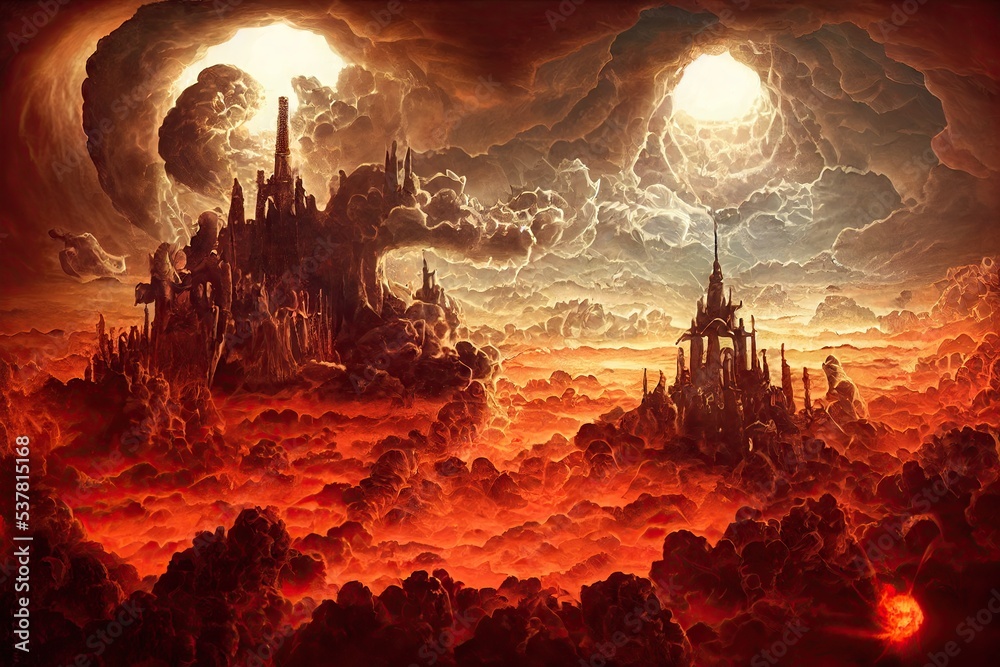
Answer: Los Angeles.
I’m kidding, guys. Sorta.
It being October and all the Halloween stuff being up, I thought “What better month than to talk about Hell, the occult, and what the heck demons are. It might not be the most original topic of discussion for this month, but at least it’s on theme. With that said, let’s talk about Hell.
Almost every major religion has an idea of what Hell is. In Hinduism and Buddhism, it’s called Naraka or Yamaloka. In the Abrahamic religions (Judaism, Christianity, and Islam), it’s called various names, like Ghenna, Jahannam, or just Hell. The Baha’i faith sort-of teaches about Hell, but it’s a very watered-down version. In other mythologies, like Greco-Roman, Egyptian, Hell was the Underworld and teachings about it would vary. I could go on.
However, though many of these religions claim some version of Hell, there are some big key differences between their version and the Christian version. Starting with the Hindu/Buddhist idea, Naraka is a temporary state of direct suffering for your bad karma. You go through there, suffer for a bit, then get reincarnated and start the process over again. Depending on how good or bad you were in life, you’ll get either get demoted or promoted in your station in life.
Then in Judaism, according to Rabbi Aron Moss, Hell is a divine washing machine to remove sin from a soul so it can enter Heaven at some point. If you’re then wondering why you should be scared of that version and repent, I don’t blame you, since either way, you apparently get to heaven.
Finally, in Islam, Hell (or Jahannam) is just a place of eternal suffering in which you get to deal with boiling water and a constant fire. There are 7 levels of it, each one corresponding to different levels of sin. However, it’s super unjust, as Allah can send whoever he chooses to Hell, even if they’ve done everything right, and if you’re a woman, you’re almost certainly guaranteed to be heading to Hell (Sahih al-Bukhari 304).
Meanwhile, in Christianity, Hell is a place of eternal torment and separation from God, where not only will unfaithful people who never repented from their sins go, but so will Satan and his cronies. While it could be that there are levels of Hell (some say passages like Revelation 2:11-15 may hint at this, but this is heavily debated), it will apply to everyone who has sinned and not repented. God takes no pleasure in sending people to this place, but He must in order to live up to his description of being just. We have transgressed His law and must be punished for it.
Moreover, in Christianity, we have the choice to either choose Hell or reject Hell. In C.S. Lewis’s The Great Divorce, Lewis writes “There are only two kinds of people in the end: those who say to God, ‘Thy will be done,’ and those to whom God says, in the end, ‘Thy will be done.'” God has given us the option to choose Him or to choose ourselves. If we choose ourselves and refuse to repent, we have dug our way to Hell and made that our eternal stop. Compare this to Islam, where Allah arbitrarily chooses whether you deserve Hell or not, even if you did everything right; Naraka, which is just as arbitrary since there can be no objective truth in polytheism and you’ll be getting out anyways; or Judaism, where it’s just the harder, longer way to get to Heaven.
Now, to end this post, I must answer the questions of, “How could an omnipresent God not be present in Hell?” and “How can a loving God send people to Hell?”
To start with the first one, when the Bible says that we’ll be separated from God in Hell, this doesn’t mean that God doesn’t exist there. What it means is that we’re separated from him in the relational sense. God wants a relationship with us. However, when we reject that grace shown in relationship, that’s where we fall into Hell. God exists in Hell, as a judge doling out punishment.
As for the second question, I already touched on this, but the loving God we’re talking about is also just. He has created a law that we must follow. When we break that law, there must be a punishment to be paid for God to continue to be just. Otherwise, He’s just arbitrary. However, He has shown His love for us by sending Jesus to pay that price for us. It’s just our choice if we choose Him or not.
Until next time,
M.J.
Discover more from The Tanuki Corner
Subscribe to get the latest posts sent to your email.
 The Tanuki Corner
Have something to say? Leave a comment! (Verbal abuse and ad hominem will not be tolerated.)