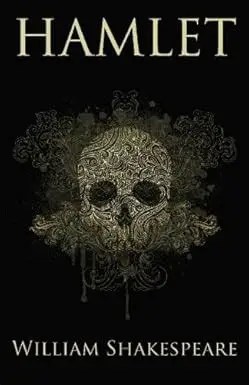
Hamlet: a play that – if you had a good education – you were forced to read in high school or had to act in if you were in theater. Nowadays, some schools are banning this book for a variety of reasons, including the heavy themes explored throughout it. Of course, this is stupid, because this wouldn’t be Hamlet if it was all just sunshine and rainbows, so let’s talk about one of Shakespeare’s darkest plays to kickstart this month’s review series of spooky literature.
#1: INSANITY!!!
The most obvious theme in Hamlet is that of vengeance turned into insanity. Hamlet is our angsty main character whose father has died under mysterious circumstances, and now he’s having to live with his mother who has married his uncle who has usurped the throne. Obviously, Hamlet is having some feelings about this, hating the situation, but it’s all exacerbated by the appearance of his father’s ghost, who tells him that his uncle killed him, kickstarting the story.
Shakespeare does an excellent job of making us feel bad for Hamlet and wanting to root for him, even though he’s going downhill mentally. We want justice for his father, but as he continues getting worse, we begin to see the darkness of the human soul taken over by wrath. In recent years, the story of the insanity spiral has become increasingly popular in T.V. and literature, especially with the advent of shows like Game of Thrones and Arcane: League of Legends having those stories in them. However, many of these stories haven’t worked out because their spirals felt rushed or the characters didn’t have good reason to go insane. Meanwhile, Shakespeare managed to pull off this storyline effectively. We know exactly what Hamlet’s motives are, the insanity builds gradually, and there’s layers to it.
The best part about the insanity, though, is that Hamlet is an act within an act. In order for Hamlet to not be suspected of anything by his family, he has to pretend to be nuts and because Hamlet does this so well, we don’t actually know when the madness truly begins. We know that it started around the time of his father appearing, however, there’s debate around when he totally loses it, if it’s during the “To be or not to be…” soliloquy, or after.
This is a mark of excellent writing. When you’ve written a character who is pretending to be insane when he’s actually going insane so well that you don’t know where the cliff is, then you have done something right.
#2: Ophelia
Ophelia is one of my favorite characters in the play because I feel bad for her. The poor girl was just caught in the wrong place at the wrong time, which caused her to go mad and eventually drown herself.
Besides that, however, Ophelia is a good representation of how one person’s wrath can affect everyone around them. Ophelia loved Hamlet and she was deeply attached to her father. At first, she was torn between loyalty to her father, Polonius, who was trying to use her to spy on Hamlet for the king, and was eventually going to help the king kill Hamlet through her, and Hamlet, whom she loved. Hamlet’s rejection of her also did not help things, especially when he starts treating her in an abusive manner. When Hamlet eventually kills Polonius and descends further into madness, it drives Ophelia over the edge, leading both to her death and the death of her innocence.
#3: Complexity
I’ve already touched on this, but this play is ridiculously complex. I’m not speaking about set design, costumes, or even the overall story. The story itself is pretty simple. But the way it’s executed throughout the text adds so many layers to the individual characters that’s extremely hard to get, especially given the length of the play. Every character has some sort of motivation that makes them interesting and enjoyable, and makes you feel bad for them when they get caught up in the horrible events transpiring.
Until next time,
M.J.
Discover more from The Tanuki Corner
Subscribe to get the latest posts sent to your email.


Have something to say? Leave a comment! (Verbal abuse and ad hominem will not be tolerated.)