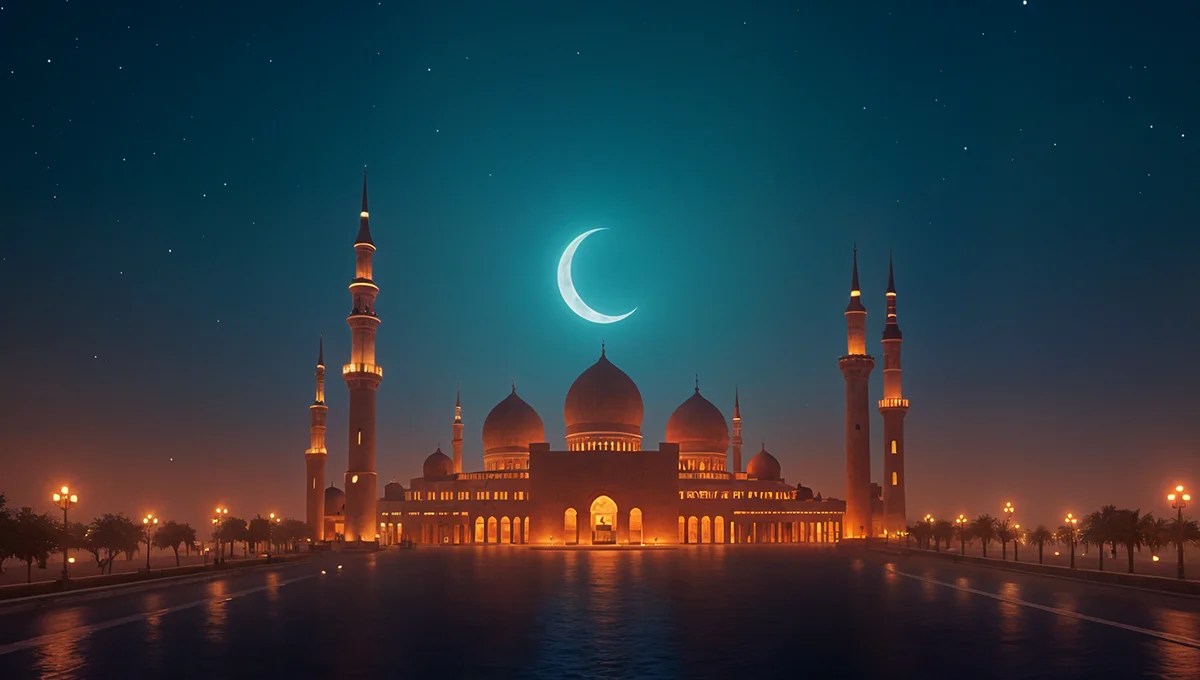
Last week, on Flippin’ Fatwa Friday, we talked about the Hajj and its pagan origins. So, this week, we’re going to talk about the pagan origins of Ramadan, the month where Muslims fast during the day, then eat a ton of food at night while applauding each other for their piousness and demand that us non-Muslims do so, too. Let’s look at the Quran’s command about Ramadan:
183. O ye who believe! Fasting is prescribed to you as it was prescribed to those before you, that ye may (learn) self-restraint,- 184. (Fasting) for a fixed number of days; but if any of you is ill, or on a journey, the prescribed number (Should be made up) from days later. For those who can do it (With hardship), is a ransom, the feeding of one that is indigent. But he that will give more, of his own free will,- it is better for him. And it is better for you that ye fast, if ye only knew. 185. Ramadan is the (month) in which was sent down the Qur’an, as a guide to mankind, also clear (Signs) for guidance and judgment (Between right and wrong). So every one of you who is present (at his home) during that month should spend it in fasting, but if any one is ill, or on a journey, the prescribed period (Should be made up) by days later. Allah intends every facility for you; He does not want to put to difficulties. (He wants you) to complete the prescribed period, and to glorify Him in that He has guided you; and perchance ye shall be grateful. 186. When My servants ask thee concerning Me, I am indeed close (to them): I listen to the prayer of every suppliant when he calleth on Me: Let them also, with a will, Listen to My call, and believe in Me: That they may walk in the right way. 187. Permitted to you, on the night of the fasts, is the approach to your wives. They are your garments and ye are their garments. Allah knoweth what ye used to do secretly among yourselves; but He turned to you and forgave you; so now associate with them, and seek what Allah Hath ordained for you, and eat and drink, until the white thread of dawn appear to you distinct from its black thread; then complete your fast Till the night appears; but do not associate with your wives while ye are in retreat in the mosques. Those are Limits (set by) Allah: Approach not nigh thereto. Thus doth Allah make clear His Signs to men: that they may learn self-restraint. 188. And do not eat up your property among yourselves for vanities, nor use it as bait for the judges, with intent that ye may eat up wrongfully and knowingly a little of (other) people’s property. 189. They ask thee concerning the New Moons. Say: They are but signs to mark fixed periods of time in (the affairs of) men, and for Pilgrimage. It is no virtue if ye enter your houses from the back: It is virtue if ye fear Allah. Enter houses through the proper doors: And fear Allah: That ye may prosper.
If you just read this by itself, there’s a very obvious issue upfront: eating. A fast is where you abstain from eating altogether. While Muslims technically do this during the day, therein lies the issue.
At best this is comparable to intermittent fasting, which is where you abstain from food for a set period of time during the day or the week before eating again. At worst, however, this is comparable to the normal fast between dinner and breakfast, especially since back in Muhammad’s time, you could at least sleep through quite a bit of the day to support your new, month-long nocturnal lifestyle.
Already, this is not looking good for Ramadan, since this becomes less of a fast and more of an upside-down dinner-to-breakfast eating schedule. But it gets worse because once the sun goes down and you’re allowed to eat again, you get to enjoy two meals. These meals, however, are massive and are the equivalent to our Thanksgiving or Christmas dinners. That means that you’re eating two giant meals at night for a month. Not only is this more feasting than fasting, but it also spells disaster for your bank account (many Muslims see their food bills increase 50-100% during Ramadan) and your digestive health.
And, by the way, this is all coming from a religion that likes to claim that it respects Jesus more than we Christians do. Apparently, Muslims never read Matthew 6 where Jesus talks about not being hypocrites and doing things just to impress people.
But moving along to the pagan aspect of all of this, a simple Google search will reveal that Ramadan and the Eid holidays are not a purely Islamic tradition that Muhammad came up with. They come from pre-Islamic paganism that centered itself around moon worship, seasonal fasting, and idolatry. In fact, some have even traced its origins to India, with Dr. Rafat Amari writing:
Both Ibn al-Nadim and the Shahrastani tell us about al-Jandrikinieh, an Indian sect which began to fast when the moon disappeared and ended the fast with a great feast when the crescent reappeared.
Similarly, Ramadan is celebrated as the 9th month of the Islamic calendar and starts with the sighting of the first crescent moon and it’s the crescent moon that ends it. In celebration of that, there’s the feast of Eid al-Fitr.
Other people who celebrated Ramadan were the pagan Sabians of Harran, who worshipped the god of moon who was ironically named Sin. According to the Religion Research Institute:
Annually, during the lunar phase when the moon was obscured—specifically the new moon’s invisibility—they interpreted this as divine displeasure. To appease Sin and hasten its return, they undertook a month-long fast, refraining from food, drink, speech, and sexual activity throughout the day, only partaking in sustenance after nightfall. Upon the moon’s reappearance, signaling divine favor, they celebrated with a grand feast termed al-Fitr. Strikingly, their fasting period bore the name Ramadan, a lexical and ritual correspondence that underscores its transmission to Islam.
So how did this get to Muhammad, and why did he adopt it as being a command from Allah? Well, according to Dr. Rafi Amari, this likely happened because the Sabians were in contact with the Ahnaf, a group of Arabs that Muhammad also had contact with before deciding he was a prophet. In fact, one of his mentors, Waraqa ibn Nawfal, was from the Ahnaf, and according to Ibn Hisham in Sirat Rasul Allah, he adopted Sabianism for a time and brought it to Arabia. Even more damning is the fact that when Muhammad started going around calling himself a prophet, the Meccans actually called him a Sabian because he would perform many of the practices they observed, such as bowing down in prayer five times a day.
There’s also the fact that Muhammad, trying to gain the friendship of many different tribes, including the Aws and Khazraj tribes, may have adopted the practice of Ramadan in order to get them to join him.
From this alone, we can see that Ramadan isn’t a divinely instituted holiday from Allah. Instead, it is based on pagan traditions meant to worship a moon god. And, once again, I must point the hypocrisy of how Muslims fault Christians for celebrating Easter and Christmas based on the popular, yet ultimately baseless claims that those holidays are based on pagan traditions and rituals.
So, sorry, Muslims. Every time when you celebrate Ramadan, not only are you destroying your bank account, your digestive health, and your sleep schedule, but you’re also destroying your spiritual health, both by Christian and Islamic standards. By Christian standards, you destroy your spiritual health via constant hypocrisy and pride, and by Islamic standards, you destroy your spiritual health as you technically commit shirk by participating in a fundamentally pagan ritual that was adopted by a false prophet for political reasons.
Until next time,
M.J.
Discover more from The Tanuki Corner
Subscribe to get the latest posts sent to your email.
 The Tanuki Corner
Have something to say? Leave a comment! (Verbal abuse and ad hominem will not be tolerated.)