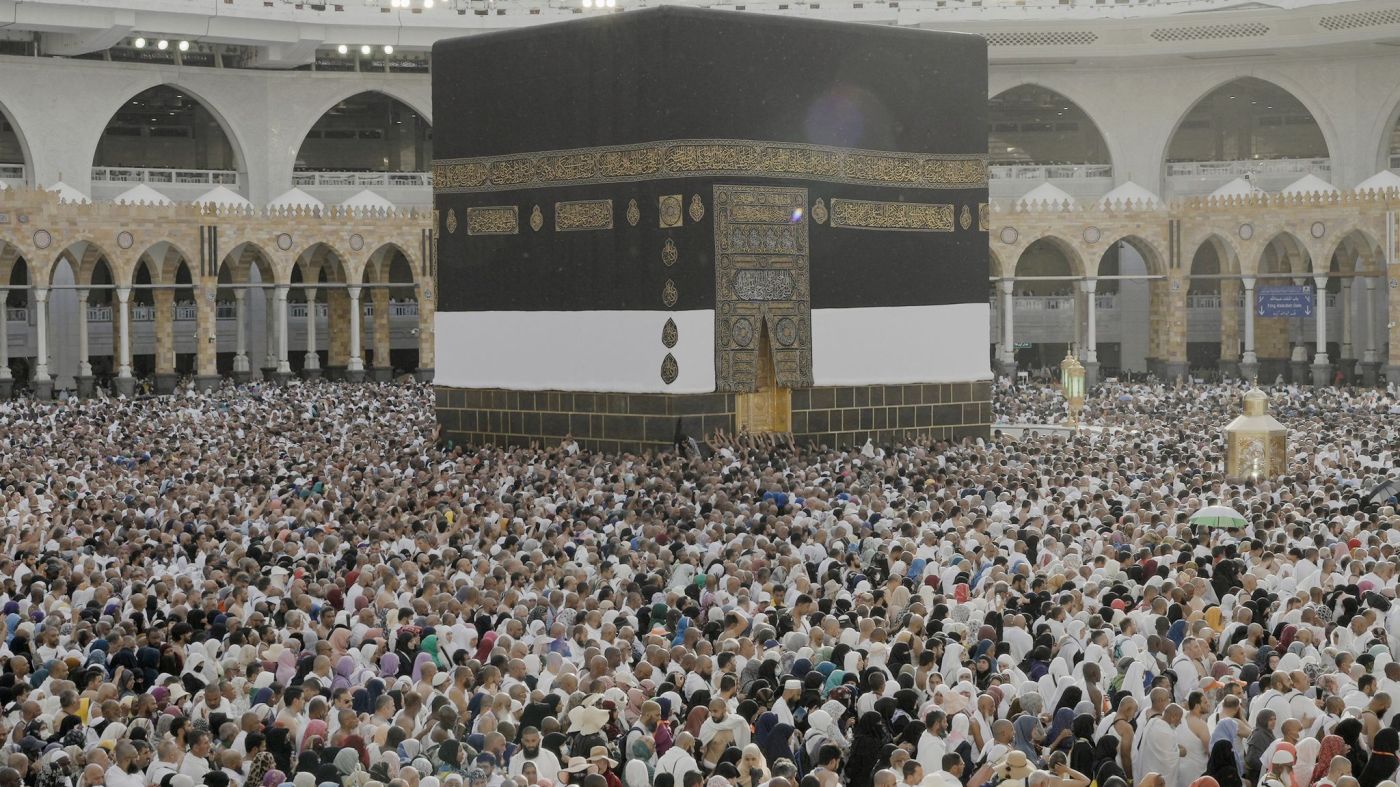
Happy month of Ram-it-down (Ramadan), everybody! It’s Islam’s holiest month, the one in which you’re supposed to fast during the day before stuffing your face with two giant meals about the size of a Thanksgiving dinner after sunset for an entire month. Why do they do this? Well, that’s going to be next week’s Flippin’ Fatwa Friday post, but today we’re going to be talking about Islam’s most sacred tradition, the pilgrimage to Mecca, a.k.a. the Hajj. More specifically, we’re going to talk about the Ka’ba and its history. Strap yourselves in, everybody, for Surah 2:122-129:
122. O Children of Israel! Remember my favor which I conferred upon you, and that I exalted you above all your contemporaries. 123. And guard (yourselves) against (the agony of) the day when no being shall avail another in anyway nor any compensation be accepted on anyone’s behalf, nor any intercession shall be profitable to anyone nor they shall be helped. 124. (Recall) when his lord put Abraham to test with certain commandments, so he carried them out. (God) said, “Verily, I will make you an Imam (- a religious leader) for the good of the people.” (Abraham) said (inquiringly), “And from among my progeny (too, do you promise to raise leaders)?” (God) said, “(Yes, but) my (this) covenant does not embrace the wrongdoers.” 125. And when we made the House (-the Ka’ba at Makkah) a frequent resort for people and (a place of) peace and security, and (we commanded), “Take to yourselves the place of Abraham (- the Ka’ba) for a center (and face towards it) during Prayer.” And we enjoined Abraham and Ismail, “Purify and clean my house for those who perform the circuit (around it) and those who cleave to it for devotion and for those who bow down (before Allah) and prostrate (to him in prayer).” 126. And when Abraham said (praying), “My lord! Make this (Makkah) a city of peace and provide its inhabitants, such of them who believe in Allah and the Last Day, with fruits.” (God) said, “And on him too who disbelieves I will bestow favors for a little while, then I will drive him to the punishment of the Fire. What an evil end!” 127. And when Abraham raised the foundations of the house and Ismail (with him, and they were praying), “Our Lord! Accept (this service) from us, you, indeed, you are the All-Hearing, the All-Knowing. 128. Our Lord! Make us both submissive servants to you (alone), and (raise) from our progeny a community submissive (and preaching virtue and submissiveness) to you, and show us our ways of worship and turn to us with mercy, for only you are the Oft-Returning (with compassion), the Ever Merciful. 129. Our Lord! Do raise among them a great Messenger from among themselves, who may recite to them your messages and teach them the Book and Wisdom, and may purify them. You, indeed, you are the All-Mighty, the All-Wise.”
I know that was a lot; the main thing to pay attention to is the stuff underlined in red since that sets up the lore for the Ka’ba.
For those of you who don’t know, the Ka’ba is a big, black, cube shaped building in the center of Mecca. According to Islamic tradition, the Ka’ba was first built by Adam to house a white stone that fell from Heaven that became black thanks to mankind’s sin. However, since the original Ka’ba fell into disrepair over time, Allah told Abraham and Ishmail to go and rebuild it, though some argue that Abraham was the first person to build it.
However, the Ka’ba building today is not the same building as what it was in Abraham’s time, as it experienced disrepair and damage over the years. Thus, it was rebuilt by the Amalekites (which I find interesting since those were the guys the Israelites were told to wipe out), the tribe of Jurham, Qusayy ibn Kilaab, the Quraish, and others before Islam became a thing.
This is where it gets interesting. Remember that stone that allegedly fell from heaven that turned black? Yeah, that thing has been revered and worshipped for thousands of years, including by the Nabataeans, who would visit the shrine once a year while on their pilgrimage. Alongside it were also an estimated 360 other idols to pagan gods. It was one of three rocks worshipped by the people of that area. One rock was red, symbolizing the god Ghaiman, and the other – a white stone – was located to the south of Mecca in Tabalaa. The white stone even had its own knockoff Ka’ba.
With that history, it’s no surprise that many people compare the Black Stone in the Ka’ba to the meteorite that was worshipped at the Temple of Artemis in Ephesus. But don’t worry. The worship of Magic-Color-Coded-Spirit-PebblesTM gets worse.
Muhammad, who was part of the Quraish tribe and lived the majority of his life in Mecca, would have been very familiar with the traditions there, including the worship of the Black Stone. In fact, we know that he was familiar with the gods worshipped there because of the Satanic Verses, in which he endorsed asking three goddess who were worshipped in Mecca for intercession to Allah according to numerous Islamic scholars such as al-Tabari.
Because of this, it’s odd that such an overtly pagan custom would be made one of the Five Pillars of Islam several times in the Quran and the Hadiths. For instance, Surah 2: 196-200 says:
196. And complete the Hajj or ‘umra in the service of Allah. But if ye are prevented (From completing it), send an offering for sacrifice, such as ye may find, and do not shave your heads until the offering reaches the place of sacrifice. And if any of you is ill, or has an ailment in his scalp, (Necessitating shaving), (He should) in compensation either fast, or feed the poor, or offer sacrifice; and when ye are in peaceful conditions (again), if any one wishes to continue the ‘umra on to the hajj, He must make an offering, such as he can afford, but if he cannot afford it, He should fast three days during the hajj and seven days on his return, Making ten days in all. This is for those whose household is not in (the precincts of) the Sacred Mosque. And fear Allah, and know that Allah Is strict in punishment. 197. For Hajj are the months well known. If any one undertakes that duty therein, Let there be no obscenity, nor wickedness, nor wrangling in the Hajj. And whatever good ye do, (be sure) Allah knoweth it. And take a provision (With you) for the journey, but the best of provisions is right conduct. So fear Me, o ye that are wise. 198. It is no crime in you if ye seek of the bounty of your Lord (during pilgrimage). Then when ye pour down from (Mount) Arafat, celebrate the praises of Allah at the Sacred Monument, and celebrate His praises as He has directed you, even though, before this, ye went astray. 199. Then pass on at a quick pace from the place whence it is usual for the multitude so to do, and ask for Allah’s forgiveness. For Allah is Oft-forgiving, Most Merciful. 200. So when ye have accomplished your holy rites, celebrate the praises of Allah, as ye used to celebrate the praises of your fathers,- yea, with far more Heart and soul. There are men who say: “Our Lord! Give us (Thy bounties) in this world!” but they will have no portion in the Hereafter.
Further in Jami at-Tirmidhi 961, we find something even more disturbing:
Ibn Abbas narrated that:
The Messenger of Allah said about the (Black) Stone: “By Allah! Allah will raise it on the Day of Resurrection with two eyes by which it sees and a tongue that it speaks with, testifying to whoever touched it in truth.”
Sunan an-Nasa’i 2919 also says:
It was narrated from Abdullah bin Ubaid bin Umair that a man said:
“O Abu abdur-Rahman, why do I only see you touching these two corners?” He said: “I heard the Messenger of Allah say: ‘Touching them erases sins.’ And I head him say: ‘whoever circumambulates seven times, it is like freeing a slave.'”
The two corners referred to here are the Black Stone itself and the Yemeni Corner (the Southwestern Corner of the Ka’ba). But strangely enough, even some of Muhammad’s buddies found this custom to be strange. For instance, Sunan Ibn Majah 2943 and Sahih Muslim 1270 record that ‘Umar bin Khattab was only kissing the rock because he saw Muhammad doing it.
Already, it’s odd that the pagan custom of worshipping a rock was endorsed by Muhammad and made to be a staple of Islam, one of the five things you have to do to hopefully reach Heaven. But it gets even worse from here, believe it or not.
The tradition of circling the Ka’ba seven times as commanded in the Quran and kissing/touching the Black Stone is something that’s a well-established pagan tradition that dates back far before Muhammad. In fact, it dates back to at least the second century, with Greek philosopher Maximus Tyrius writing that the Arabians would pay homage, “to I know not what god, which they represent by a quadrangular stone.” Numerous other historians also wrote about the pagan tradition of going to the Ka’ba for worship. Even Sahih Muslim 43:7179 records that pagan women would go around the Ka’ba naked and Sahih Bukhari records that the Arabs would worship stones.
So why would Allah, through Muhammad, command that a fundamentally pagan tradition be used to worship him? And why would Muhammad teach that the pilgrimage to the Ka’ba will absolve you of your sins? Last I checked, if Allah is the same thing as the God of the Bible, then he has a long track record of destroying pagan sites, many of which involved worshipping some sort of idol made out of stone. Why wouldn’t he do the same thing with the Ka’ba?
This is just more proof that Allah is a false god and couldn’t be more different from the God of the Bible. And meanwhile, the Muslims say that Christmas is a pagan tradition? I don’t think so.
Until next time,
M.J.
Discover more from The Tanuki Corner
Subscribe to get the latest posts sent to your email.
 The Tanuki Corner