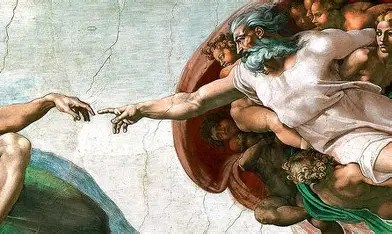
If you read Friday’s post, you’ll know that I talked to a practicing Hellenist (who I will call E), and one of the things she brought up was that the reason it’s (sort-of) okay for the gods to act how they do in Greek Mythology is because they have created their own set of laws that apply only to them and us puny mortals have similarly created our own laws via consensus that apply to us. Unfortunately, I didn’t have the opportunity to explore that more with her while I was at the Expo since I got sidetracked, but getting home, the more I thought about it, the less it made sense. If the gods’ morals were all subjective and were just agreed upon by the group, and man’s morals were created in a similar manner, then aren’t the gods acting unethically when they force their subjective morals upon humans that we didn’t agree on? Moreover, in Hellenism, what separates us from the gods is “miasma” or ritual impurity brought on by daily life. But who’s to say that we should be separated for that reason if everything is subjective? Why is it bad? Why is hubris (extreme pride to the point where you believe you’re God) the highest sin in Hellenism if sin doesn’t exist unless it’s deemed sin by the mob? And, more importantly, if all laws (which must be based on some sort of truth) are subjective, how is the universe able to act in a rational, logical manner? The more I thought about that, the more I realized just how much more rational and aligned with reality the Christian, monotheistic God is and why that matters so much.
What I realized after thinking about what E said is that, for one thing, having a monotheistic God in charge of creating the universe and its rules makes way more sense and is much more practical than having a million gods trying to agree on what to do. Think of it in the terms of having too many chefs in the kitchen. If there’s one chef with one idea of how he wants to make a dish, things will go in a more orderly manner, and he may even get the dish done faster. However, if there are several other chefs, the kitchen will be crowded, people might have other ideas for what the dish should be, and overall, it’ll be more chaotic.
Another way to think of it would be if you’re a writer coming up with a fantasy world. As the sole author of that world, you can do whatever you want with it and its inhabitants. You know and get to determine how that world works, what your characters are going to do, etc. Meanwhile, if you have another person (or two, or three) helping work on it at the same time, they likely won’t share the same vision for that world, will have different writing styles and preferences, and you’ll have to compromise. It might even get so bad that people will be able to tell that there were too many people working on it because things will be retconned or convoluted, or the writing styles may differ drastically.
Now apply this to the creation of the world. With a single, monotheistic, all-powerful, all-knowing God creating the world, His subjective will becomes our objective reality. As the sole author of the world, God can make whatever truths and rules He wants that align with His character and that’s the truth we look to as objective. We are – to some extent – like characters in a book that He’s written. As characters living in that book, we are subject to the rules that the author has established and that is the norm for us.
However, in a polytheistic/pantheistic religion, it’s much different. Looking at the Greek creation myth, the first god was literally named Chaos (Khaos in Greek). He (or, rather, it) was the initial state of the universe that somehow, out of its disorder, created the original gods, like Nyx, Tartarus, Gaea, Eros, Ouranos, etc. who somehow created order. Already, that’s confusing and illogical, and even reminds us of the atheistic idea of creation (somehow, without cause, the universe spontaneously exploded from nothing, and evolution happened), but the creation of the world gets worse as through a series of mating with pretty much everyone, incest, violence, murder, and cannibalism, the world and its gods came into being. For every aspect of reality, there was a god for it. In fact, it was recorded by a dude named Petroneous that it was easier to find a god in Athens than a man because of how many statues of the gods there were.
What this means is that reality all had to be determined by consensus in a poly/pantheistic worldview. Everything is ruled by the subjective rules of a massive group of gods. There had to be compromise. And when it comes to humans, we’re pretty much on their own when it comes to creating our own laws, unless the gods have something to say about it, in which case it’s an unethical rule by force.
What this also means is the polytheistic/pantheistic belief of the creation of the world cannot line up with reality. The world has been created in a very logical and rational manner. There’s a reason why we know that no matter the size or weight of an object, it’s acceleration due to gravity will always be 9.8 m/sec2 . There’s a reason why 2+2=4 and not 5. There’s a reason that through experimentation, we can understand the world around us. If the world were created by a group of gods creating rules by consensus based off their subjective experiences – being the physical embodiments of order from disorder, which logically can’t happen – then all those rules would be based on subjective truths as well.
If you don’t believe me, think about why it’s generally a legal requirement to put railings on walkways that are high off the ground. We agree that having legal requirements for those railings is an objective moral good because there’s an objective truth that gravity exists. If we don’t put those railings there, there’s a good chance that someone could accidentally fall and either severely hurt themselves or die. If gravity was only a subjective truth, then it wouldn’t be a requirement to have those railings. It also wouldn’t be a crime to push someone off the side of the Grand Canyon because who knows? Maybe their truth was that gravity doesn’t exist so they’ll just float.
[Author’s Note: This is also the same problem with atheism. Reason cannot come from non-reason. If the world exploded from a massive cosmic accident with no rhyme or reason for it, the universe cannot be logical.]
Meanwhile, in the Christian worldview, because there’s only one God creating the world, the truth He’s created is our objective truth and thus, our objective morals. No one can change it. When He created the world, the world wasn’t created through war, violence, incest, etc. It was created in a six-day period with one day to rest, in a logical manner (Gen. 1-2). This is important because this lines up with what we know about reality, including our theory about the Big Bang, which was created by a Christian.
However, if polytheism, pantheism, and atheism don’t line up with reality under these standards, then does this mean that all monotheistic religions are good and line up with reality?
No.
For example, Islam is a religion where the first half of its creation story is pretty similar to the Bible’s. It’s less detailed but is pretty much the same until you get to the Creation of Man and the Fall. At that point, it stops lining up with reality because it denies that humans are inherently sinful, a belief that anyone who has a toddler knows deep down is wrong. While humans aren’t inherently evil, we aren’t inherently good, either. We all have a great capacity to sin, and often, we choose the path to sin. Denying that is to deny reality and really screws up your understanding of Man.
Therefore, if you’re someone who is curious about religion and are trying to figure out what religion to go with, you should really start with what it believes about creation. Does it line up with reality? Does it adequately explain why things are? Does it make logical sense? If not, then that’s not a religion that should be believed because already there’s a million logical red flags.
Until next time,
M.J.
Discover more from The Tanuki Corner
Subscribe to get the latest posts sent to your email.
 The Tanuki Corner