I had heard it said by several of my friends that junior year was going to be the worst year of high school…and they were kind-of right.
It wasn’t that it was the absolute worst year of my life or anything. What made it the hardest academic year for me was just the massive workload I decided to pile on myself because…why not? My mom had given me control of what subjects I wanted to study and when it came time to choose which literature programs I wanted to do this year, I had to choose to do either American Literature (which went with my history and economics course) or British Literature, which didn’t go with anything but would be fun, nonetheless. Thus, I decided to do both at the same time subjecting myself to having to write at least 2 essays a week on top of the weekly essay required by American Literature with random research papers thrown in for finals. And this was on top of other electives, running this blog, and everything else in-between.
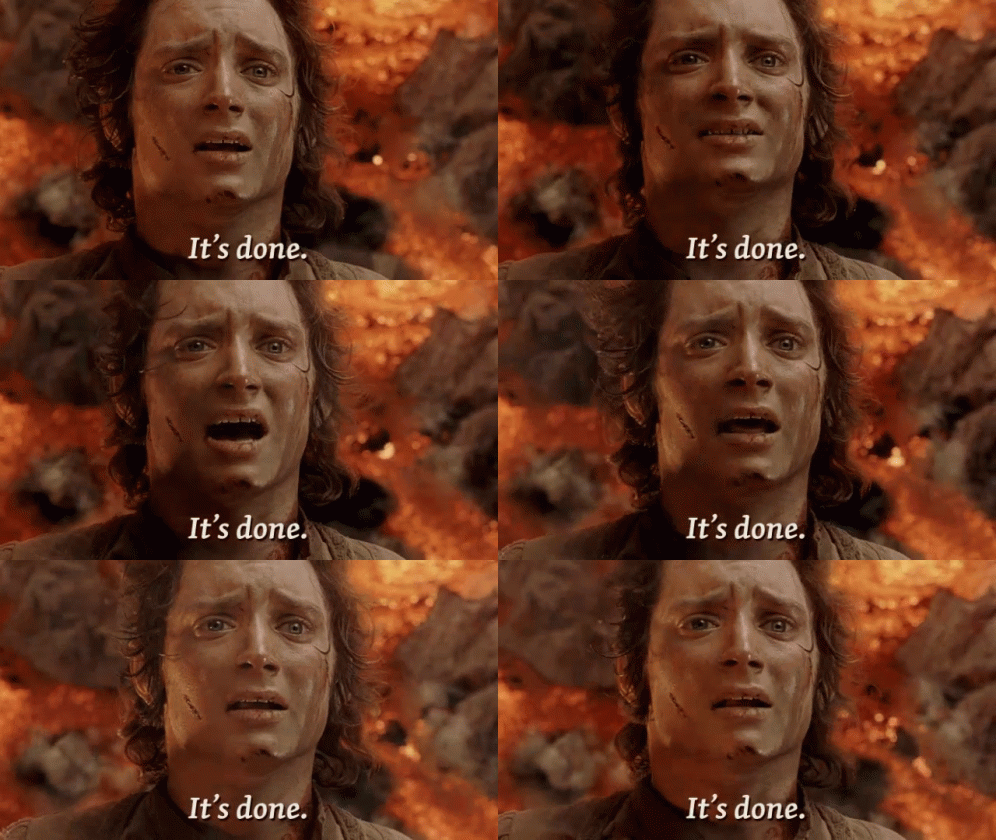
Needless to say, I hit burnout after completing the first semester, kept chugging along, and now I’ve finally hit summer break feeling like Frodo after getting rid of the Ring (hence today’s thumbnail).
However, that isn’t to say that all of it was bad. Despite the burnout and heavy workload, I’m glad that I did both at the same time as not only did I get a unique experience reading works written by Americans versus those written by the Brits at the same time, but I also got to read a lot of books that I may have otherwise never read, some of which I’ve already reviewed here on The Tanuki Corner. So, here’s the top ten books from junior year that I would recommend everyone read at some point.
#1: Up From Slavery by Booker T. Washington
I put this at the top of the list due to our current socio-political state. I did a post about this book back in February so if you’re interested in my full thoughts on this book, you can read it there. In short, I think everyone should read this book because it shows how not all of our problems are necessarily caused by systemic pressures and prejudices or whatever nifty words the Left likes to use to say that you’re a victim. While those things can be present and cause problems, your life is ultimately defined by your decisions, for good or ill. If you’re not willing to work hard, then you’re not going to go anywhere, no matter how much head knowledge you may have.
#2: Beowulf
This was the first book I read in British Literature and I’m so glad it was the first book of that course because this is the most important book in English literature. So many stories that have come out of Britain (most notably the work of J.R.R. Tolkien) have been influenced by Beowulf to some extent, so it can be a great starting place to find certain themes and character types and use that as a point of comparison for other stories. If you really want to have fun, I recommend reading the Seamus Heaney translation, as it also includes Beowulf in the original Old English it was written in, which is fun to try to read correctly. Try to find the words that we still use today.
#3: Paradise Lost by John Milton
Paradise Lost is a bit of a hefty read, but it’s one that you’ll get a lot out of. Based on the opening chapters of Genesis, it’s a beautifully written story that skillfully explores the themes of pride, love, and the Fall of Man. Similar to Beowulf, it has also influenced much of literature, media, and culture and continues to today, so reading it is a must for any literature nerd.
#4: Canterbury Tales by Geoffery Chaucer
Rich in satire, social commentary, and humor, Canterbury Tales is a book that’s sure to amuse readers centuries after it was written. Though it’s a collection of vastly different stories told by different people from many different backgrounds, the narrative is skillfully held together by its campy feel thanks to the pilgrims’ shared travels.
#5: Hamlet by William Shakespeare
Really anything by Shakespeare could go on this list, but Hamlet being his most famous play and (sadly) the only one included in my British Literature course, this is the only one I can put here. Just like with Beowulf and Paradise Lost, Hamlet has had a lasting impact on literature, media, and culture, making it an essential read. It’s a prime example of excellent character building and writing as the characters (especially Hamlet) are multi-faceted and complex as the plot explores pride, vengeance, madness, and power. It’s perfect read for the Halloween season.
[Author’s Note: I didn’t know this, but the other day I found out that Shakespeare’s works are actually being censored in schools, most notably in Florida of all places. Top colleges are also no longer requiring a working knowledge of Shakespeare if you’re shooting to become an English major, which is just absurd due to his lasting impact on the English language.]
#6: The Adventures of Huckleberry Finn by Mark Twain
I’ve written about this one. An all-time classic and favorite of mine, this book is the epitome of American literature, inspiring other American authors such as Ernest Hemingway, William Faulkner, and F. Scott Fitzgerald. It’s one of the earliest examples of social commentary being mixed with humor and even if you’re not reading it for school, it’s a book that’s just a really fun, leisurely read.
#7: My Antonia by Willa Cather
Set in the late 19th century, My Antonia is the story of a Bohemian girl named Antonia who moves to the fictional settlement of Black Hawk, Nebraska. It’s an emotionally deep coming-of-age story that brings the American West to life, highlighting the life and struggles faced by immigrant families at that time.
#8: The Grapes of Wrath by John Steinbeck
I was disappointed to find out that humor columnist Dave Barry was in fact joking when he said in his book, Dave Barry Slept Here: A Sort Of History of the United States, of the Great Depression and The Grapes of Wrath: “This troubled era was chronicled brilliantly by John Steinbeck in his moving novel The Grapes of Wrath, part of a series that also includes The Pinto Beans of Lust and Bloodsucking Death Cabbages from Hell.”
I would’ve read Bloodsucking Death Cabbages from Hell, but alas! It doesn’t exist.
What Barry wasn’t joking about was that The Grapes of Wrath did brilliantly chronicle the effects of the Dust Bowl and the Great Depression. It’s full of emotional depth and accomplishes its job of trying to make you feel bad. Just like with Adventures of Huckleberry Finn, it’s another American classic. The only thing I have to complain about is the ending, which I felt was weird, but to each their own. I won’t give away any spoilers.
#9: Frankenstein by Mary Shelley
This isn’t the Frankenstein you’ve seen in the movies and T.V. shows. While those adaptations often try to make the story more comical than it really is, they miss the depth of the original work. This is another book that I’ve already written about, but to sum up my thoughts about it, it’s one that I would recommend reading soon after reading Paradise Lost because it takes so much from Milton. While Milton was writing from a Biblical worldview and was an adherent of the idea of original sin brought on through Adam and Eve, Shelley was an atheist who held to the belief that permeated the 19th century view of man that everyone is inherently good and it’s through ignorance that man is evil. This is reflected in Frankenstein’s monster, who, because of his lack of knowledge and companionship becomes evil and makes it his mission to make Victor Frankenstein’s life a living hell. It’s a philosophically challenging and terrifying work that’s an early example of transhumanism in literature and I highly encourage everyone to read it.
#10: A Tale of Two Cities by Charles Dickens
Charles Dickens was one of the most prominent social commentators and literary/social realism writers of his time, with much of his work focusing on the injustices of society. A Tale of Two Cities is probably the capstone of his work as a social realism writer as it compares the injustices of London and Paris during the time of the French Revolution. In it, Paris shares many of the injustices of London, but due to the extremity of its problems, needs more social reform, but the way the French go about it is a stark warning to us that vengeance is not the answer to fixing these problems.
Until next time,
M.J.
Discover more from The Tanuki Corner
Subscribe to get the latest posts sent to your email.
 The Tanuki Corner
Have something to say? Leave a comment! (Verbal abuse and ad hominem will not be tolerated.)