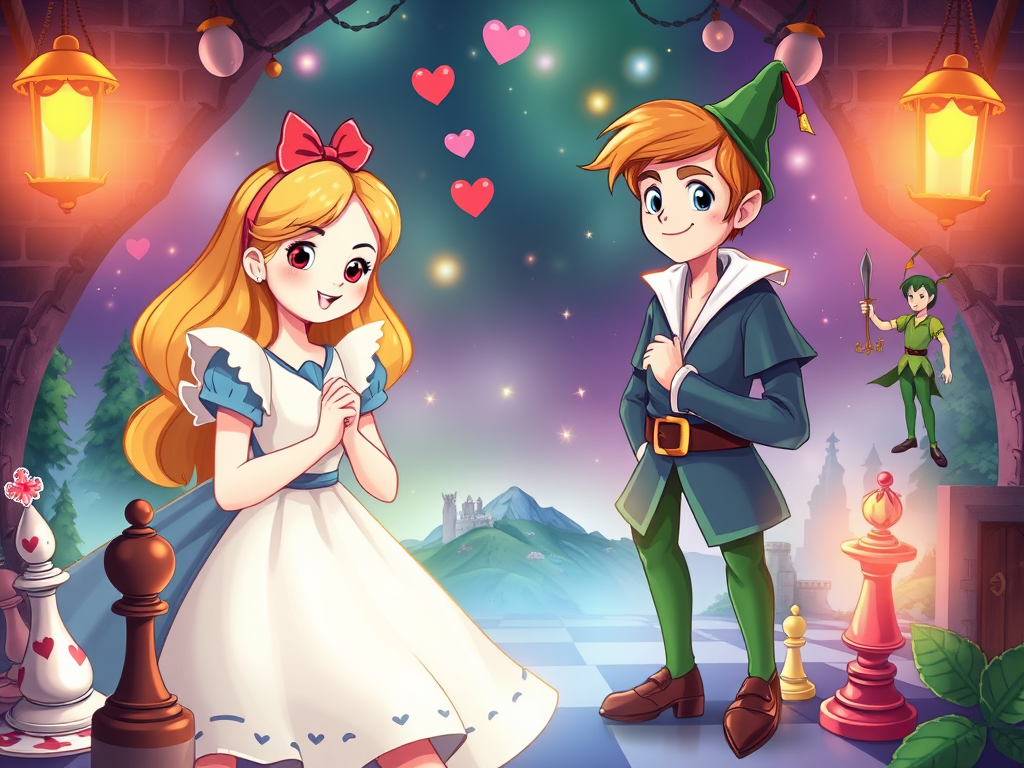
Two books that I was assigned for my class on British literature was Lewis Caroll’s Alice’s Adventures in Wonderland/ Through the Looking Glass and Peter Pan by J.M. Barrie. Both are classic children’s stories that I was familiar with growing up, but it wasn’t until I read them this year that I realized that both stories have deeper meanings, both reflecting on childhood and children’s imagination. Peter Pan shows the darker side of childhood, highlighting the callousness of children and their imagination, while Alice’s Adventures in Wonderland is much lighter, but still dark as it shows the strangeness of childhood imagination.
To start with the similarities between Caroll and Barrie’s work, both stories do an incredible job of showing how a child’s imagination is often shaped by the things around them and how real it feels to them. In Alice’s Adventures in Wonderland and Through the Looking Glass, the characters are often based off of games, sayings, characters, and poems she would be familiar with. The most obvious examples of this are cards that the Queen of Hearts rules over, the kings and queens in Through the Looking Glass which are chess pieces, Tweedle Dee and Tweedle Dum, Humpty Dumpty, etc. Similarly, Peter Pan has this to some extent in the world of Neverland. Neverland is a world full of pirates, fairies, Indians, and mermaids, all things that were common in children’s stories at the time the book was written. Everything feels real to the children, though it is clear that it’s imaginary.
Another similarity between Alice and Peter is that these worlds are almost universal for everyone. At the end of Alice’s Adventures in Wonderland, Alice tells her older sister about Wonderland and her sister seems to recognize it. It seems as though she’s been there before, and she knows that someday, her kids and Alice’s kids will experience Wonderland as well. We see this, too, in Peter Pan when Wendy grows up and her daughter goes with Peter to Neverland. It’s a world that never ends and Peter never grows up or dies, continuing to delight generations of children. Both Wonderland and Neverland are places that every child experiences at some point and remembers. They are immortal because they’re representative of the innocence and wonder of childhood.
However, this is where the two start to diverge. Caroll’s story – as strange as it is – is much more innocent and happier than Barrie’s. Part of this is because Alice never changes. She’s a flat character. She’s the same throughout Alice’s Adventures in Wonderland and its sequel, Through the Looking Glass. She is still sweet and naïve as the story goes on. She never matures.
The other part of how the story retains its innocence is through its dreaminess. In the beginning and the end, it’s made clear that Alice in dreaming. The threats in Alice’s Adventures in Wonderland are fairly vague and when the Queen of Hearts wishes to cut off Alice’s head, she escapes easily when she wakes up. Even in Through the Looking Glass, the recognizable threats of the Jabberwocky, Bandersnatch, and Jubjub bird are all only alluded to. Alice is in no real danger and if she is, she can easily wake up and get out of it.
Meanwhile, the danger in Peter Pan is much more real. When Wendy, her brothers, and the Lost Boys are captured by Captain Hook, they can’t just get out of it by waking up. Their imagination is reality for them now. If they die in Neverland, they die in the real world as well. The danger is to be taken seriously there. That’s why Peter’s character, as fun as he is, is actually quite terrifying. He primarily cares for himself and his wellbeing and doesn’t seem too preoccupied with making sure everyone else is safe. One of the best examples of this is when the children are going to Neverland and Peter has to be consistently reminded by Wendy to save her siblings when they’re falling after falling asleep and he often forgets who they are and why they’re there.
Not only that, but because of Neverland’s blurring of the lines between reality and imagination, there’s also the danger that the children’s mothers may forget about them if they don’t come back. Though they greatly enjoy Neverland, they realize that they need their families, forcing the kids to follow Wendy’s lead and grow up by leaving Neverland and returning home. Wendy (a static character) eventually grows up and raises her daughter on tales of Neverland, letting her go there with Peter when he returns.
The last difference between Neverland and Wonderland is that Neverland is more unpredictable. Because it’s more real, you have to roll with the punches there and you have no quick way out. Meanwhile, because Wonderland is controlled by the one dreaming it up, it’s more predictable. It’s based off of your experiences and so, you have a better idea of how to deal with things.
Until next time,
M.J.
Discover more from The Tanuki Corner
Subscribe to get the latest posts sent to your email.
 The Tanuki Corner
The entire idea of Peter Pan is just scary, once you think about it
LikeLiked by 1 person
Yeah. The idea of some random small child coming in, kidnapping you kids to go do God-knows-what, with the chance you may never see them again is only slightly disturbing.
LikeLiked by 1 person