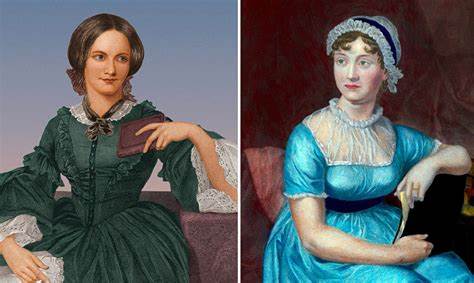
Jane Austen and Charlotte Brontë are two of the greatest female authors to have ever lived. Charlotte Brontë, having been born a year before Austen died, was familiar with her work and famously said of Pride and Prejudice in a letter to George Henry Lewes in January 1848: “Miss Austen being, as you say, without ‘sentiment,’ without poetry, maybe is sensible (more real than true), but she cannot be great.” For many fans of literature, this critique of Jane Austen’s work raises the question of what does it mean to be more real than true? Can rational sensibilities exist in a story with the strong emotion that Charlotte Brontë so valued? In this quote, we can see that while Brontë was correct about Jane Austen’s portrayal of what was real (which was a reflection of how Austen grew up), she perhaps lacked the insight to see the “’sentiment’” that was shown in Austen’s work though it was not as great as what was seen in the Gothic genre that Brontë and her sisters wrote in.
The first thing to take into consideration when comparing the work of Jane Austen and Charlotte Brontë is to consider how these two writers grew up. Though Austen and Brontë were both the daughters of clergymen where creativity was greatly valued, they had vastly different upbringings. In the case of Jane Austen, life in the Austen household was much more stable than that in the Brontë household. According to the writers of janeausten.com, “By all accounts, life inside the Austen homestead was a casual environment where many an attempt at humor was made with some very good debating going on on the side.” Austen was the seventh of eight children with one sister, Cassandra and was very close to her father. Her household valued creativity, dialogue, and learning and would often put on homemade productions based off existing plays or their original creations, allowing Austen to hone her observations, improvisation, acting, and participation skills. Additionally, Jane Austen was homeschooled alongside Mr. Austen’s live-in pupils and because of Mr. Austen’s status as a clergyman, she was able to learn from his vast library. Though this also played a large role in honing her creative skills, her brothers also helped give her a view of the world that not many people had. Her brothers, Francis and Charles were in the Royal Navy and James was an officer in the militia and they would often send news of the world in their letters; Henry was a clergyman who later proofread Jane’s novels; and Edward later became the heir to Jane’s wealthy cousins, allowing Jane and her sister to partake in the life of the landed gentry, which is portrayed in many of her novels.
Meanwhile, the Brontë sisters, though they’re the most famous literary family, were much less fortunate. They lived in the poor town of Haworth with their father, poet and author Patrick Brontë, which was so greatly affected by the Industrial Revolution that the average life expectancy was no more than 22. Death was a common thing in their childhood, and they saw it firsthand when the oldest Brontë sisters, Maria and Elizabeth, both contracted tuberculosis and died at the ages of 8 and 10 and their mother died at the age of 38. Because of this environment, the remaining Brontë siblings had to fend for themselves with the help of their spinster aunt, which did not leave much time for developing their literary genius as they were forced to watch out for each other. Their brother, Branwell would only go to Haworth Grammar school for a few years, while the sisters only received two and half to one and a half years of formal education before resorting to learning from home.
Despite this, however, the Brontë siblings were all very creative and together created stories that would lay the groundworks for their later literary ventures. As adults, Ann and Emily would go on to be governesses and Charlotte would become a teacher at her old boarding school of Roe Head, which, combined with their previous experience at boarding schools, informed much of their writing, leading early biographers and critics to believe that they had based much of their books off real-life experiences and places.
From this, we can see how the individual experiences of these authors would shape their tastes in writing. In the case of Jane Austen’s upbringing, we can see how from an early age, she was encouraged to pursue writing stories that were more in line with the genre now known as social realism. Social realism was a genre that arose as a platform for social critique and societal change that emerged in the late 19th and early 20th century. It would often deal with determinism (external social, economic, and environmental factors), the injustices faced by the working class and migrant workers due to industrialization and urbanization, and materialism. It offered poignant social critique, showing everything in a hyper realistic light, allowing the reader to examine the human condition and the world, focusing on everyday struggles in a microcosm.
Though Austen’s work wasn’t directly put in this category, we can see how it was a sort of early example of this genre. Her works certainly centered around portraying the lives of people in the middle-class and both the criticism of her work provided by Charlotte Brontë and the applause it received from publishers reflected those that were common for the genre. For example, Jane Austen’s stories often center on characters who are put in ordinary situations (such as needing to find a husband) that become more dramatic as the story progresses, with one of the best examples of this being her first published novel, Sense and Sensibility which explores themes of economic influences on marriage during the Regency era while delving into the psychology of how healthy those matches really were. The Critical Review praised Sense and Sensibility “for its ‘naturally drawn’ characters and its realistic plot: ‘The incidents are probable, and highly pleasing and interesting.’” Another good example of this is Pride and Prejudice (Jane Austen’s first full novel), which was similarly loved for its realism and natural portrayal of characters and situations, setting it apart from gothic novels of the time.
Austen’s early work was also very satirical, with the story Susan becoming the story Northanger Abbey around 1789-1799. It poked fun at the gothic novels that Austen was familiar with, showing how many of the scenarios enacted in the genre were ridiculous and could lead to misconceptions and immaturity when misread. It taught the audience to laugh at the improbable as the young, naive main character learns to understand herself and others outside of the influence of her beloved gothic novels.
Meanwhile, the gothic literature that Austen satirized in Northanger Abbey was a stark contrast to the social realism movement and it’s no surprise why. The genre first appeared in the late 18th century, being a darker offshoot of the romantic genre (which in of itself had first appeared as a counterpoint to the Age of Reason) and the term used to describe it originated in the subtitle of British author Horace Walpole’s The Castle of Otranto: A Gothic Story. It became memorable for its combinations of supernatural elements, romance, adventure, decaying settings and brooding atmosphere that implied a sense of foreboding, mystery, and fear. In the shadows of the genre’s mysterious settings, authors could question societal norms and expectations and explore themes having to do with psychological torment, the fragility of the mind, and forbidden desires through such outlets as their brooding heroes, virtuous damsels-in-distress, and tyrannical villains. Though it was not as popular in the 1800s as it had been in the beginning, it was still very popular in the 19th century as Romantic authors like Sir Walter Scott and Victorian writers adopted the genre. However, just like with the social realism genre, it was not without its criticisms. Having drawn from the Romantic movement, the gothic genre drew deeply on sensationalism in every aspect of the plot, from the atmospheres to the characters themselves, leading to moral ambiguity and often formulaic plots.
It was in this gothic genre that Charlotte and her sisters wrote, inspired by the writings of Lord Byron, Ann Radcliffe, Horace Walpole, Gregory Lewis, and Charles Maturin. In 1847, all three sisters published their respective books: Jane Eyre (Charlotte’s), Wuthering Heights (Emily’s), and Agnes Gray (Anne’s), published under the pseudonyms of Currer, Ellis, and Acton Bell. Though their works are now considered masterpieces and people were attracted to them for their passion and originality, the Brontë sisters’ books were considered scandalous due to the social mores of the time. Jane Eyre did the best of all three books but received mixed praise and condemnation and Emily’s book, Wuthering Heights, was seen as unfit for genteel society, with the plot considered coarse and the characters deemed unlikeable. To quote James Lorimer in his critique of Wuthering Heights, “Here are all the faults of Jane Eyre are magnified a thousand-fold, and the only consolation which we have in reflecting upon it is that it will never be generally read. This is a strange book […] it is not without evidences of considerable power: but, as a whole, it is wild, confused, disjointed, and improbable.” From this criticism, the Brontë sisters were portrayed as being coarse, brutal authors and Charlotte, after the deaths of Emily and Anne, wrote a biographical notice of her sisters in 1850, seeking to portray them as they had been in life: unlearned, unworldly women who wrote by instinct.
With this understanding of how these women grew up and the genres that they wrote in, we can now understand what Charlotte Brontë meant when she said that Jane Austen wrote what was real, not what was true. Brontë’s definition of “true” referred to the feeling and portrayal of the deepest human emotions: love, hatred, jealousy, joy, fear, etc. These were all feelings that were very commonly portrayed in their extremes in gothic novels and it’s easy to see how Brontë would prefer this portrayal of emotions as she had grown up seeing and feeling these extremes. However, Jane Austen recognized that while these extremes were “true” and did happen in real life, she also recognized their indulgences as being potentially unhealthy. Austen shows this in Sense and Sensibility in the character of Marianne, a hopeless romantic who happily indulges in her emotions as she clings to the ideals of the Romantic movement, something that almost kills her. Austen knew where the line was crossed between what amount of sentiment makes a character feel human and when it seemed to just be there for shock value. Thus, if we see “true” as only being a term referring to emotional excess, then Brontë’s critique was correct. However, if “true” should refer solely to the act of feeling emotion, then Brontë sorely misjudged Austen’s work, which skillfully combined reality with the sentiments of everyday life.
Until next time,
M.J.
Discover more from The Tanuki Corner
Subscribe to get the latest posts sent to your email.
 The Tanuki Corner
I honestly think that you could create a homeschool curriculum, because this is so well written, I’m surprised at how much I liked it, despite not reading any books like what these authors write. I learned more than I expected (and with your blogs, I expect to learn a lot).
LikeLiked by 1 person
The Bibliography for this post:
“Brontë Family.” Wikipedia, The Free Encyclopedia, Wikimedia Foundation, https://en.wikipedia.org/wiki/Brontë_family. Accessed 2/25/25.
“Bronte Sisters.” English History, Hanson, Marilee https://englishhistory.net/victorian/famous-people/bronte-sisters/. Accessed 2/25/25.
“Brontë Sisters: The First Family of Literature” History Cooperative, Brown, Beth Keith https://historycooperative.org/brontes-group-portrait/ . Accessed 2/25/25.
“Gothic Literature: And Then There Was Poe” ThoughtCo, Kennedy, Patrick https://www.thoughtco.com/gothic-literature-2207825 Accessed 2/25/25.
“Gothic Literature in English.” English Studies, https://english-studies.net/gothic-literature-in-english/. Accessed 2/25/25.
“Home.” Jane Austen Society of North America (JASNA), http://www.jasna.org/. Accessed 2/25/25.
“Home.” Jane Austen, https://www.janeausten.org. Accessed 2/25/25.
“Social Realism in Literature – Literary Theory – English Studies.” English Studies, https://english-studies.net/social-realism-in-literature/ . Accessed 2/25/25.
“Social Realism.” Wikipedia, The Free Encyclopedia, Wikimedia Foundation, https://en.wikipedia.org/wiki/Social_realism. Accessed 2/25/25.
LikeLike