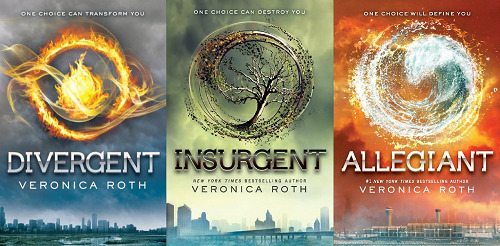
I realize that this view has been expressed by many people after Divergent‘s release in 2011 and its later movie adaptation in 2014, but after reading the entire Divergent trilogy in 2022, my thoughts on this book series can no longer be contained. As someone who has read a lot of young adult fiction ranging from really good to absolutely horrible, I would have to put Divergent as somewhere between “mediocre at best” and “garbage”. Here are my top three reasons why you shouldn’t waste braincells on this series.
#1: The Plot
For the first half of the first book, the plot moved slowly, though that was forgivable since the story still had a pretty well-defined structure. Though I did have some problems with the practicality of the world building (something I’ll get to in a second), Veronica Roth did a good job setting up a general idea of the social structure and what life was like for Tris (the main character) that led her to leave Abnegation and join the rough-‘n-tumble life provided by Dauntless. For the first half of the book, the plot is all about Tris’s growth from being a shy, timid girl to becoming someone who is more confident and outgoing.
From there, the plot is flushed down the toilet as it becomes more about Tris’s questionable relationship with Generic-Hunky-Brooding-Wattpad-Boyfriend, Four (a.k.a., Tobias) and ends with her finding out she’s the Divergent and must join with a group of rebels fighting against the Erudite faction who are controlling the city and are trying to weed out anyone who poses a threat to the system. Books Two and Three (Insurgent and Allegiant), are about this fight…sorta. Most of Insurgent is about Tris’s relationship with Tobias while her mental health declines to almost unreadable levels because its so poorly written (tip for writers: making your character constantly suicidal to the point of stupidity and not writing them a growing from that is not character growth. It just makes your book a slog to read through, does not help people who are actually suicidal or have suicidal tendencies, and makes your reader root for the villian).
Allegiant is slightly better and tries to get what should be the main plot back on its feet, but the story was so interrupted by the poorly written drama and angst that it fails spectacularly. Slow pacing throughout the last two books and inconsistent plot points leave the reader wondering what the heck they just read at the end. Especially since every character – especially Tris and Tobias – might as well be NPC’s who are just doing what the plot needs them to do, leading me to my next point….
#2: The Tris and Tobias Relationship
This was the worst part of the entire book and is what ruined the plot. While most young adult series include questionable or blatantly abusive relationships between the heroine and her boyfriend (looking at you, Twilight), this one is easily the worst relationship I have read about. Not only is it creepy since Tris is dating the person who was basically her teacher in the first book, but Tobias clearly doesn’t care for her in any meaningful way. Its clear to any reader with more than five braincells that Tobias is only there for one thing: sex. Veronica Roth tries to fix this by commenting multiple times on Tris’s small chest and sickly frame and by writing a scene where Tobias tells Tris that if he was only dating her for sex, he would’ve run off with one of the much prettier girls in Duantless. However, his actions show otherwise since the only time Tobias acts decently around Tris is after they just made out for a page or two, after he just groped her for awhile, or an implied sex scene. The rest of the time, he is a vindictive, patronizing jerk who is only there for Tris when the plot needs him to be.
How is this romantic?! What sort of example is this setting for the main audience of 10-14-year-old girls?
This isn’t to lay all the blame on Tobias. Tris is equally as horrible in the relationship. While she may not be abusive like her boyfriend, she acts like an airhead whenever he’s around and becomes even more insufferable. Though Veronica Roth claims to be a Christian and claims to try to put Christian role models and morals into her books, she fails horribly to do anything that would make Divergent have any sort of Christian message (other than referencing God here and there), and I definitely would not call Tris’s actions “Christian”. Though Tris says in the first book that she’s not comfortable having intercourse outside of marriage and has the strength to say “no” to the simulation Tobias when he tries to hook up with her, she compromises constantly everywhere else. She allows herself to get into situations where she is borderline doing the deed and in the last book its implied that she crossed that line. Once again: What sort of example is this setting for pre-pubescent and teen girls? This isn’t romantic, this isn’t Christian by any means, this isn’t appropriate in a book for young adults.
#3: The World Building
Though the first book does a good job of using “Show; Not Tell” to give everyone a general idea of the world Veronica Roth created, the set up simply isn’t practical. The setting of Divergent takes place in the Chicago area after a huge apocolyptic event (or something along those lines; its never really specified) has occured and most of humanity has been wiped out. Over the years, the remaining humans have built their own cities/countries to live in and try to create a perfect breed of human since whatever happened before screwed with their genetics. However, the problem with the location of the main city in Divergent is the fact that in the story, we’re told that Lake Michigan had dried up and turned into a huge swamp land. While I can forgive the idea that Lake Michigan had dried up and been filled in with dirt in a relatively small amount of time thanks to this being a post-apocolyptic world, Lake Michigan is a central part of the climate and livlihood of Chicago and the surrounding cities. Not only would its absence cause hotter, drier summers and potentially harsher winters, according to the Chicago Tribune, the lake provides 70% of all fresh water to the city. Without the lake, it would be hard to provide water to all the residents of Divergent’s Chicago, not to even mention growing crops since there are no references to any sort of retention ponds or reseviors.
Secondly, the entire idea of people being split into five different factions based mostly on personality traits is absurd. While it’s an interesting idea, no one would fit perfectly into any one faction. Shortly after reading the book, I took a quiz to find out which faction I’d be in (and I know these Internet quizzes aren’t 100% acurate, but I’ll use it for the sake of analogy). On the first attempt I got Abnegation and on the second recieved Candor. Everyone would have to be a mix of at least two or more factions to one extent or the other.
Lastly, the idea of there being a Divergent who’s being hunted by everyone is stupid on the front of the plot of the last book. While in books 1 and 2, the plot of the government hunting Divergents to wipe them out because they can’t be controlled makes sense (and creepily rings true of many totalitarian governments today), the plot of book 3 is about how the scientists want to get rid of the Divergents. This makes no sense since they were the ones who put the remaining humans in the small cities in the hopes that they would eventually breed out the imperfect genes, the Divergent ultimately being the result of that. Why would they want to destroy the product of their labor if it’s what they wanted?
Final Review
Should you – as a parent reading this or a fellow teenager – buy the Divergent trilogy? If you’ve made it this far, you shouldn’t have to guess that my answer is a definitive “no”. While there were some highlights to the story here and there, none of those highlights come from the main characters and are often overshadowed by the meandering plot that constantly falls off the traintrack to focus on another, poorly-placed subplot that doesn’t actually push anything foward. Most of the characters are just there to do what the plot needs them to do and you find yourself suspending your disbelief so much that the story doesn’t feel compelling. Instead, it feels like you are reading fanfic written by a 12-year-old girl. If I had to sum up this book in a sentence, that sentence would be: Veronica Roth figured she could make some money riding on the heels of the massively popular Twilight and Hunger Games franchises. However, I’ll leave the floor to you and let you decide.
Until next time!
M.J.
Discover more from The Tanuki Corner
Subscribe to get the latest posts sent to your email.
 The Tanuki Corner
Have something to say? Leave a comment! (Verbal abuse and ad hominem will not be tolerated.)